 Written by HLRBO Staff|
Last updated
As of August 3, 2026, exactly one state has published a 2026 acorn reading, and it says two opposite things: an excellent white oak crop and a red oak group with virtually no production. There is no national mast picture this year, because nobody assembles one.
Wisconsin Is the Only State With a 2026 Reading
The Wisconsin DNR released its 2026-27 regulations and fall forecast series on July 22, 2026. Inside the West-Central District deer forecast, written by DNR wildlife biologist Darren Ladwig, is the only agency mast language in print this season: the annual acorn survey at Sandhill Wildlife Area "indicated an excellent mast year for white oak," while "the red oak group had virtually no acorn production."
Read that carefully. The Sandhill survey is described as last fall's count, which makes it a reading carried forward rather than a 2026 field measurement. The forecast says what to do about the gap: when scouting in mid-August, hunters should be "looking in the canopies to ascertain the extent of mast crop in their specific location." A state biologist is telling you, in a state document, that the state document is not granular enough for your stand.
The 2026 State-by-State Picture, and Where It Goes Blank
Here is every state checked, and what each has on the record right now.
Wisconsin: the only published 2026 mast language, excellent white oak and near-zero red oak in the West-Central District. Kentucky: nothing yet, and there cannot be, because the Department of Fish and Wildlife Resources walks its statewide routes, typically about 25 of them, between August 15 and September 1, a survey KDFWR reports it has run since 1982. Ohio: nothing yet, since Division of Wildlife staff scan oak canopies at select wildlife areas each summer and publish in the fall. West Virginia: nothing yet, with the DNR and the Division of Forestry surveying 18 species of trees and shrubs annually ahead of archery season. Virginia: nothing yet, with 32 hard mast sites surveyed each year by DWR and partner agencies, some mountain routes in place since the 1950s. Pennsylvania: no 2026 release, though the Game Commission's deer habitat material documents a 27-year Huntingdon County study of extreme year-to-year swings. Missouri: no formal mast survey at all, with acorn conditions appearing inside Department of Conservation harvest analysis after the season closes. Georgia: nothing yet, and the most recent North Georgia Oak Acorn and Hickory Nut Survey posted by the Wildlife Resources Division covers 2025 and went up on September 11, 2025. North Carolina: nothing yet, with the Western North Carolina Hard and Soft Mast Survey publishing after its fall count. Minnesota: 2026 regulations released July 27 with no mast component.
Connecticut, New Jersey, Pennsylvania and Virginia coordinate through the Oak Mast Surveillance Program, and each state completes its own annual acorn assessment. Connecticut's Agricultural Experiment Station monitors 300 red oaks and 275 white oaks, 575 trees in all, inside Connecticut during a two-week August window. The other three states survey separately and report their results into the same program. That is the closest thing to a regional mast picture in existence, and it covers four states out of fifty.
A national 2026 acorn map does not exist in any single place, and it will not exist in August, because most of the counts have not been walked.
One Season Versus Two Changes What the April Freeze Could Do
The two oak groups run on different clocks, and the distinction is not folklore. University of Missouri Extension states it precisely: acorns in the red oak group "take 15 months, two growing seasons, to mature," while "white oak acorns are less bitter and mature in three months, one growing season."
That carries a consequence this year. White oak acorns falling in October 2026 were pollinated in spring 2026. Red oak acorns falling this October were pollinated in spring 2025, and were already set on the branch before this spring happened.
Now put the calendar against it. Record lows hit the Mid-Atlantic on April 20 and 21, 2026, including 24 degrees at Allentown, 27 at Dulles, 28 at Charlottesville, and 9 degrees in West Virginia's Canaan Valley. Missouri Extension notes the mechanism directly: "Species in the red oak group can provide an acorn crop in years with a late spring freeze that might have destroyed the white oak acorn crop."
Nobody has published a 2026 mast count for the freeze zone, so treat that as a mechanism and not a forecast. It has a testable signature: if a hard-freeze April suppressed Mid-Atlantic oaks, the shortfall should show in white oak and not red oak. Wisconsin runs the other direction, white oak strong and red oak absent. Those are not the same problem, and they do not call for the same hunting.
What a Boom Does to Deer, and What a Bust Does
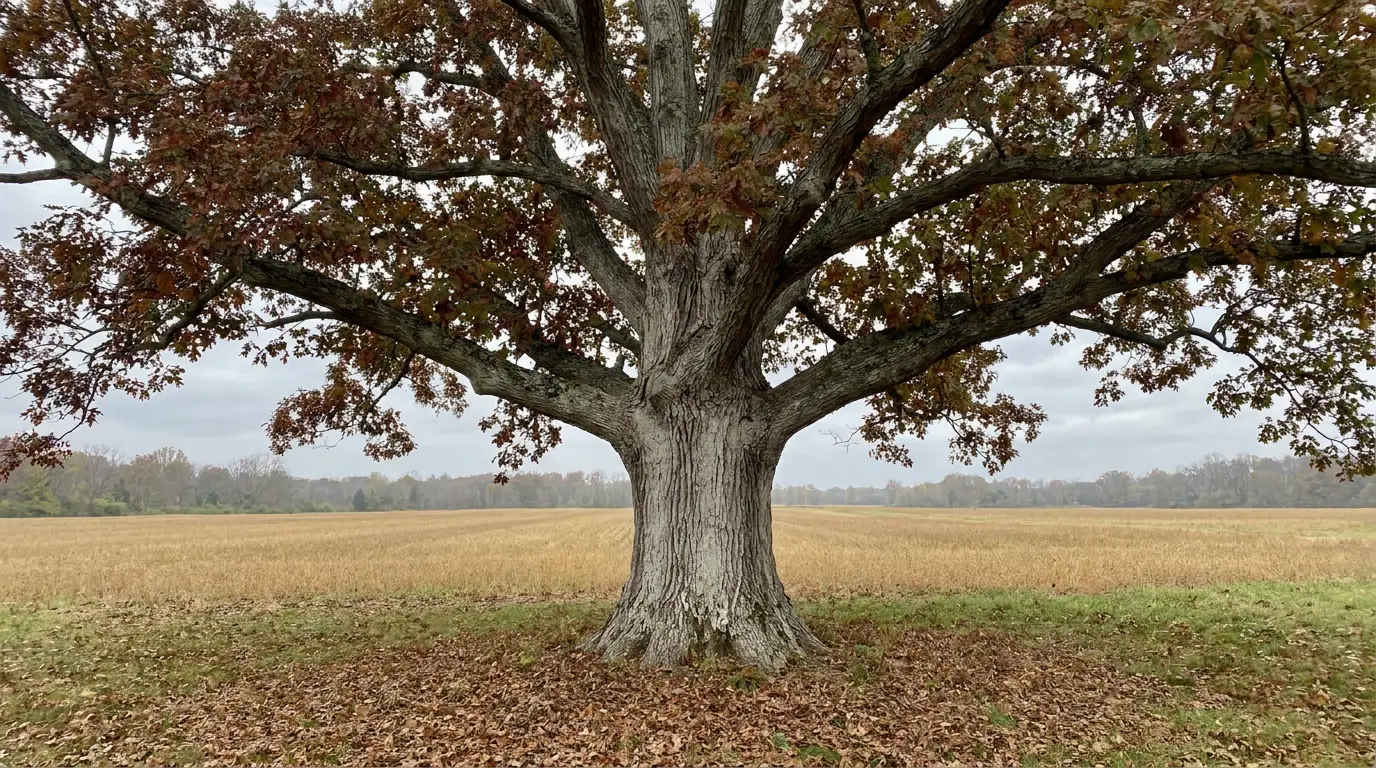
A heavy crop scatters deer and hides them. Virginia DWR's Katie Martin put it plainly in the state's most recent acorn report: many wildlife species "will likely be less mobile throughout the fall as they target these high-calorie food sources," and as a result "may not use open fields, food plots, and other early successional habitats as readily."
Missouri gives the harvest arithmetic. MDC Cervid Program Supervisor Jason Isabelle attributed a drop to a bumper acorn crop: "When that happens, deer don't need to move nearly as much to find food, even within the timber, and they frequent fields less often because of the abundance of food in the woods." The largest declines were in forest-dominated Ozark counties. Statewide, harvest fell from a record 326,448 to 276,262, a loss of 50,186 deer, about 15 percent. The next season, with what MDC called a more typical acorn crop, harvest came back to a preliminary 301,954, the figure MDC itself labels preliminary, recovering a little over half of it. Season-date changes moved some of that, so read it as an order of magnitude.
Hunting the Boom and the Bust
In a boom year, hunt individual trees rather than food sources. North Carolina state deer biologist Moriah Boggess cites research by Dr. Marcus Lashley in which "a third of the white oaks in a stand produced 75 percent of the total acorn crop." Deer select within a species, not only between them, because white oak acorns are "much more digestible and highly selected by deer." Boggess names the trap: "Deer quickly change their focus between trees, causing spots to go cold overnight as deer shift from one tree to the next." A boom-year stand is a perishable asset. Hang two, and be willing to move at midday.
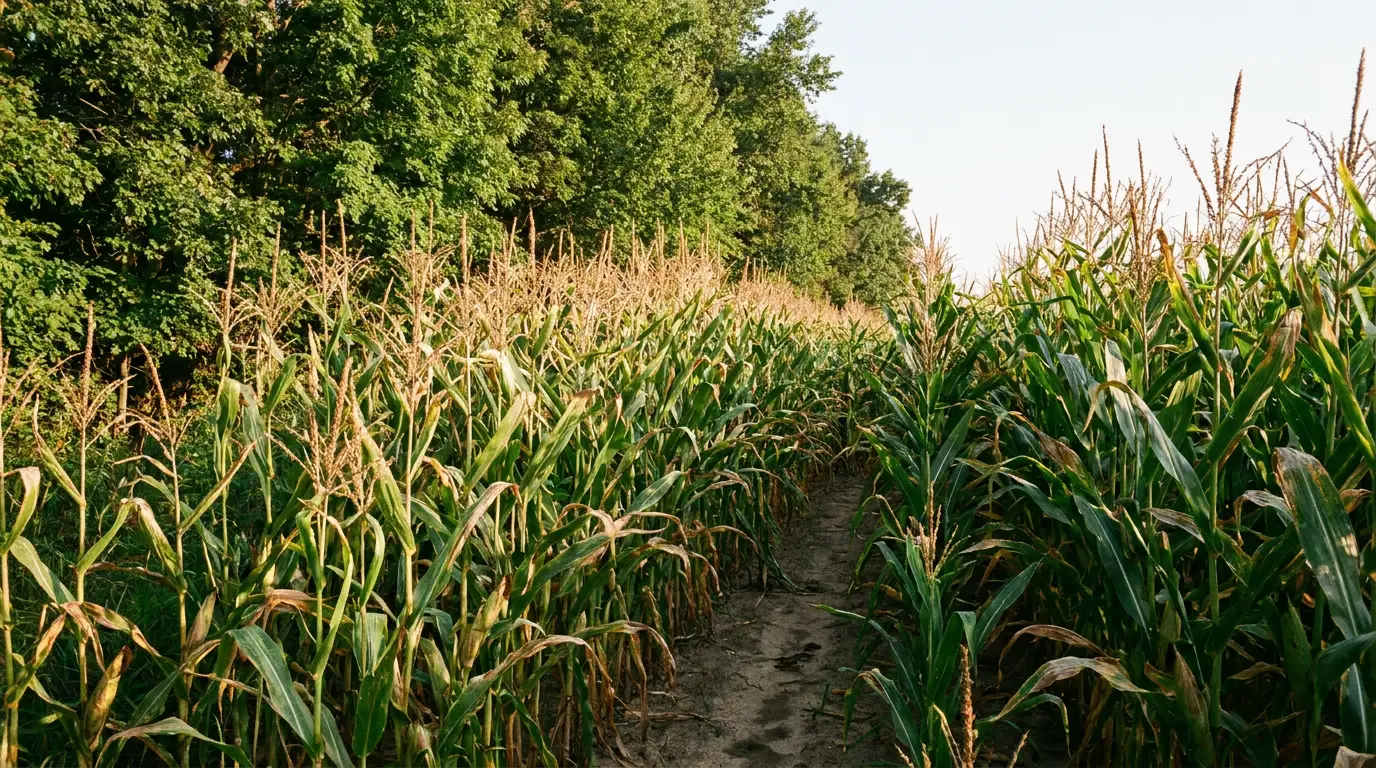
In a bust year, go back to edges. A red oak failure removes the late-season carryover, the acorns that persist on the ground into December because their tannin load slows consumption, and it pushes movement onto standing ag, brassicas, cut corn and browse. That is the year a green field or a standing corner earns its keep, and the year an oak-only property gets quiet. West-Central Wisconsin looks like that year.
Here is the strongest argument against all of it: a state-level mast number is nearly useless at stand scale. Missouri Extension reports that among white oaks, "only about 30 percent of large, healthy trees produced any acorns even during years of good production." Pennsylvania's 27-year Huntingdon County range of 0 to 582 pounds per acre is variance on the same ground, not between properties. The useful survey is the one you run yourself in mid-August with binoculars, exactly as Wisconsin instructs.
The Two-Year Lag, and the Case for Mixed Oak
Acorns do not only decide where deer stand this October. Pennsylvania Game Commission material notes that abundant acorn crops "can lead to increases in body weight and antler growth," and the literature on mast and deer condition finds the effect trailing the crop by a year or two, with birth weights and fawn survival in hardwood forests tracking the previous year's hard mast. This fall's acorns are partly a doe-condition input for next spring's fawns. A bust year is a hunting inconvenience and a recruitment cost you read in 2028.
Which is the practical case for mixed oak. Mississippi State Extension recommends a 50 to 60 percent oak component split evenly between red and white, because that mixture "provides a safeguard against a total acorn crop failure in any given year." A property with white oak, red oak and ag has three independent failure modes, and 2026 is a year when two of them are out of phase. A single-cover-type property has one, and it either carries you or it does not.
HLRBO connects hunters with landowners across the country, with verified listings, real lease agreements, and secure payments behind every booking. When you compare properties, read the cover types the way you would read a mast survey. Find a lease or subscribe to become an HLRBO member here.