 Written by HLRBO Staff|
Last updated
Biting midges do their heaviest work in the last stretch of August, and by the time an agency confirms the first epizootic hemorrhagic disease case of a season, the outbreak that produced it has usually been running for weeks. As of August 16, 2026, the 2026 record this piece can vouch for is a single state map, posted by Missouri and stamped August 9, 2026, with no county list and no count behind it. A thin record in mid-August is ordinary, and it is not the same thing as a quiet year. What decides your season is not a national tally anyway. It is what your own state agency has put on its disease page, so here is what EHD does, what it looks like on the ground, and where to go read your state's answer for yourself.
What EHD Is, and Why Late Summer Belongs to It
Hemorrhagic disease is the umbrella term for illness caused by two related orbiviruses, epizootic hemorrhagic disease virus and bluetongue virus. The Southeastern Cooperative Wildlife Disease Study at the University of Georgia calls it the most important infectious disease of white-tailed deer, and its surveys documented illness or death in 875 counties across 31 states in the 1980s alone.
Neither virus passes from deer to deer. Both move through the bite of a Culicoides midge, the insect a hunter knows as a no-see-um. The Pennsylvania Game Commission puts it plainly: outbreaks occur when deer congregate in wet areas during the driest part of late summer and early fall, when seasonal midge activity peaks, and they end when the first hard frost kills the midges and any viruses they carry. Michigan's DNR makes the same point from the deer's side, noting that the virus must pass through the insect.
This is not a herd contagion you can slow by spreading deer out. It is an insect problem with a hard calendar ending, which is why the next six weeks are the ones that matter.
The Field Signs, and Why Deer Die at the Waterline
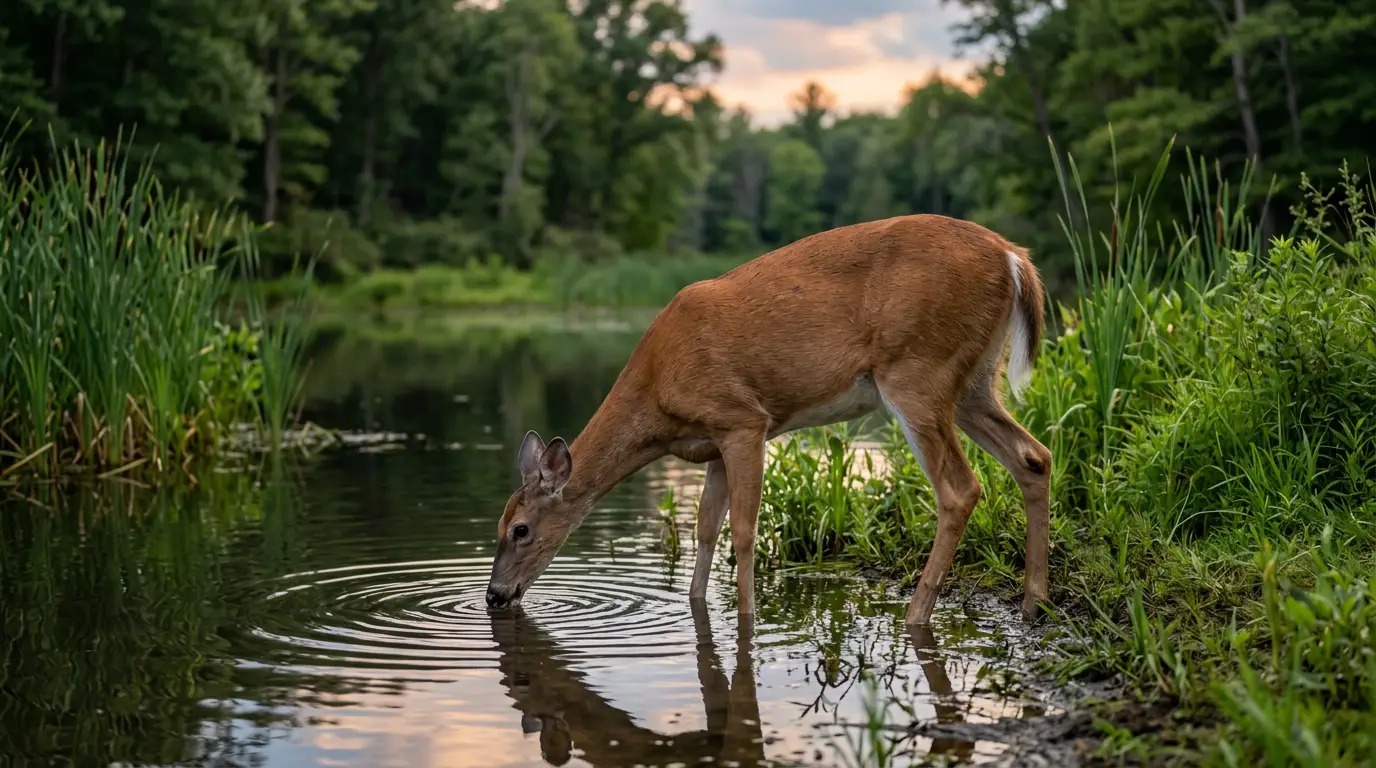
The virus produces a high fever, and a feverish deer goes to water. That is why the first evidence most people find is a dead deer at a pond edge rather than a sick one in a field. Cornell's Wildlife Health Lab describes fever and edema producing a swollen head, neck, tongue, or eyelids. Missouri's Department of Conservation adds lameness, labored breathing, and weight loss, and notes that most deer die quickly enough to show no obvious signs at all.
Quickly is not a figure of speech. Pennsylvania puts acute mortality at 8 to 36 hours from the onset of clinical signs. Deer that survive carry the receipt into the season in their hooves, and Cornell documents hoof abnormalities in chronic survivors, including sloughing of the hoof walls. That is the sign a hunter finds on a live deer in October rather than a dead one in August.
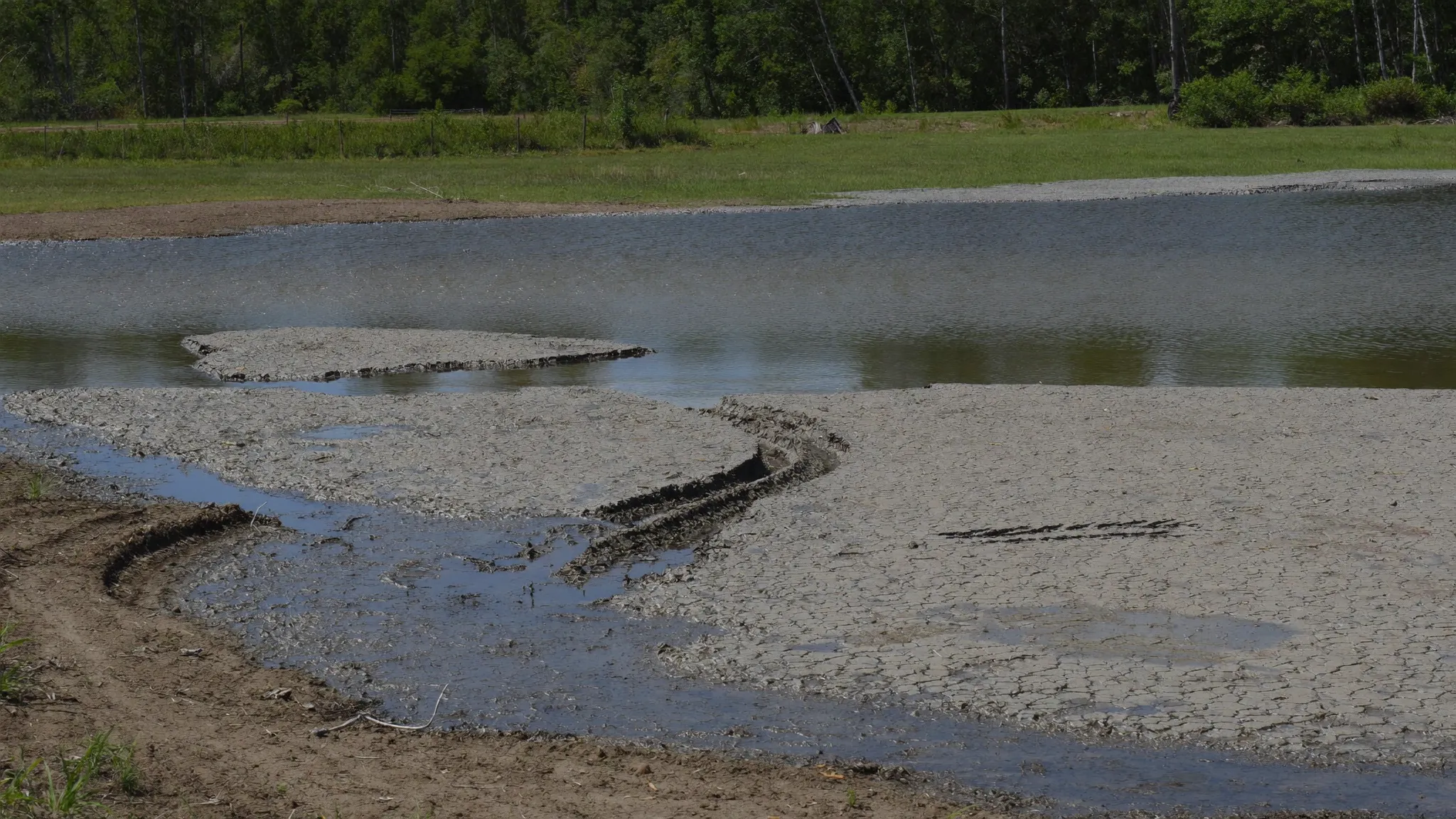
Drought is not required. It is an accelerant. Missouri's 2012 losses came during an extreme drought when deer gathered around limited water, and the mechanics are simple: shrinking ponds leave warm, disturbed mud margins close to ideal midge habitat, and thirsty deer visit them more often. Wherever you hunt, watch for a wet early summer running into a hard dry August.
This year that setup has moved north. The U.S. Drought Monitor release valid August 11, 2026 puts the sharpest deterioration in the Northern Plains, with much of North Dakota and central and southwestern Kansas under 25 percent of normal precipitation, while the Ohio Valley took more than two inches of rain. Last season's death zone is currently the wet part of the map.
What the 2026 Record Actually Shows
One state has posted anything at all for this year. Missouri's hemorrhagic disease page carries a "2026 Cases" heading over a state map image stamped August 9, 2026, with no release, no county list and no count attached to it. That map is the entire positive 2026 record this piece is willing to stand behind.
The honest way to report the rest is to show the method instead of announcing a verdict. On August 16, 2026 this piece opened six state agency disease pages and read what was on them. Missouri's is described above. Indiana's still leads with its September 26, 2025 event notice for seven southern counties. Kentucky's still shows a 2025 map. New York's outbreak table ends at 2025, with Niagara County logged as a low-severity year. Pennsylvania's and North Dakota's are general explainers that carry no year-stamped case data in either direction. Michigan's newsroom would not load for this check, so read Michigan as unchecked, not as quiet.
Six pages is not the country. Nothing above is a finding about any state whose page is not named in it, and the point of listing them is so you can repeat the check rather than take our word for the shape of the season.
Line up the 2025 season's announcements and they land later than most hunters assume. Idaho Fish and Game confirmed its first Clearwater Region case on August 20, Michigan confirmed four counties on September 2, an Eastern Region outbreak in Washington was reported on September 10, and Indiana declared a significant event on September 26. Add Missouri's August 18 request and that is five notices, of which only two came before September and none before August 18.
Mid-August is not universally too early, though. Ohio had confirmed cases in 13 counties by August 12 in the 2022 season, per the National Deer Association's tracking, and Michigan confirmed its first 2024 case, a deer from St. Joseph County, in late July of that year. Silence today is weak evidence, and it says more about lab turnaround than about the midges working a creek bottom right now.
The accounting does not close quickly at the other end either. Michigan's 2025 total, roughly 3,000 deer across 16 counties where EHD was lab-confirmed, was not presented to its Natural Resources Commission by DNR veterinarian Scott Larsen until March 2026. Against Michigan's 2012 event, an estimated loss of more than 14,000 deer in more than 30 counties, that is about a fifth of the deer across half as many counties.
EHD Is Not CWD, and the Venison Question Has a Real Answer
These two get conflated constantly, and the distinction is not academic. Virginia's Department of Wildlife Resources lays it out: chronic wasting disease is caused by a misfolded prion, spreads through prions shed in saliva, urine, and feces, and averages about 23 months from infection to death. Hemorrhagic disease is a virus carried by an insect and kills in hours. CWD accumulates in a herd across years. EHD burns through a neighborhood and stops at frost.
On human health the agencies are unambiguous. Pennsylvania states the viruses are not known to cause disease in humans. Michigan's DNR states there is no evidence that humans, pets, or other wildlife can contract the virus, and that venison harvested in EHD-affected areas is safe to eat. Indiana's DNR notes no established public health risk from handling or eating infected animals.
The caveat is about condition, not contagion. New York's DEC states that thorough cooking kills the virus but recommends against harvesting or eating any animal that appears sick or diseased, and Missouri explains why: the disease can weaken an animal's immune system, allowing secondary bacterial infections that make the meat unsuitable. Do not shoot a deer that looks sick. Report it. New York and several other states will discuss a replacement tag if a hunter surrenders the carcass.
Why One Lease Loses Its Season and the Next One Does Not
EHD mortality is intensely local, and the 2025 Ohio numbers put a figure on how local. Through the first six weekends of archery season, Washington County's harvest ran under 15 percent of its three-year average while Meigs County, inside the same outbreak footprint, ran just under 33 percent, according to figures given to the Ohio Wildlife Council. One county lost more than twice as much season as a neighbor in the same event. Clint McCoy, deer biologist for the Ohio Division of Wildlife, told Ohio's Country Journal it was the most extensive such mortality event of his decade there.
The consequence for a leaseholder is uncomfortable. A property scouted in July can be gutted by September while ground ten miles away is untouched, and no due diligence at signing predicts it. The counter-argument deserves its strongest form: some managers believe water design moves the odds. Retired USDA researcher Ed Schmidtmann points to shallow, murky, disturbed-bank water as the place to look for midge larvae, and the National Deer Association reports the practical version: deeper water, steeper vegetated margins, shade, and no mineral sites at the water's edge. Dr. Dave Stallknecht of the University of Georgia frames the odds honestly, saying that if it were a gamble he would take it, and that if your neighbors are not doing the same you may have limited success.
That is the case for spreading a season across more than one parcel, and for landowners reporting mortality and telling their hunters what they are seeing. A report in August gives a hunter six weeks to adjust. Silence until opening day does not. Michigan's DNR offers the reassurance that matters on the lease side: after 2012, local herds rebounded within a couple of years and were fully recovered in four to five.
The date that ends this is the first hard frost in your county. The date before it is whenever your state agency posts its first 2026 confirmation, which on recent form lands between mid-August and late September. Check the page, not the rumor.
HLRBO connects hunters with landowners across the country, with verified listings, real lease agreements, and secure payments behind every booking. Find a lease or subscribe to become an HLRBO member.