 Written by HLRBO Staff|
Last updated
Tennessee began selling a Deer Bait Privilege License on July 22, 2026, and for the first time in state history, hunting white-tailed deer over corn is legal there. The state made it legal by charging for it.
The Tennessee Wildlife Resources Agency announced the license on July 15, one week before it went on sale through GoOutdoorsTennessee.com and the TWRA On the Go app. It costs $50 for a resident and $100 for a nonresident, and it runs 365 days from purchase, not to the end of the license year. It covers only private property, owned or leased, and it travels with the hunter across every private tract that hunter can access. Nobody is exempt. All hunters wishing to hunt white-tailed deer over bait "are required to purchase this license regardless of exemptions, lifetime licenses, and age."
The authority is Public Chapter 444, Senate Bill 869 by Sen. Joey Hensley with Sens. Lowe and Stevens, substituted for House Bill 938 by Rep. Kip Capley with Reps. McCalmon, Doggett and Littleton. The General Assembly passed it April 22, 2025, Gov. Bill Lee signed it, and it took effect July 1, 2025.
The act rewrote Tennessee Code Annotated 70-4-113, which lists bait alongside pitfalls, snares and poison, and carved deer out of it for license holders. Violations remain a Class C misdemeanor.
The act also gave the Tennessee Fish and Wildlife Commission until August 1, 2026 to define acceptable bait and how much may be used. The commission approved those rules on December 5, 2025. They take effect August 1, 2026, with the license valid beginning with the 2026-27 season.
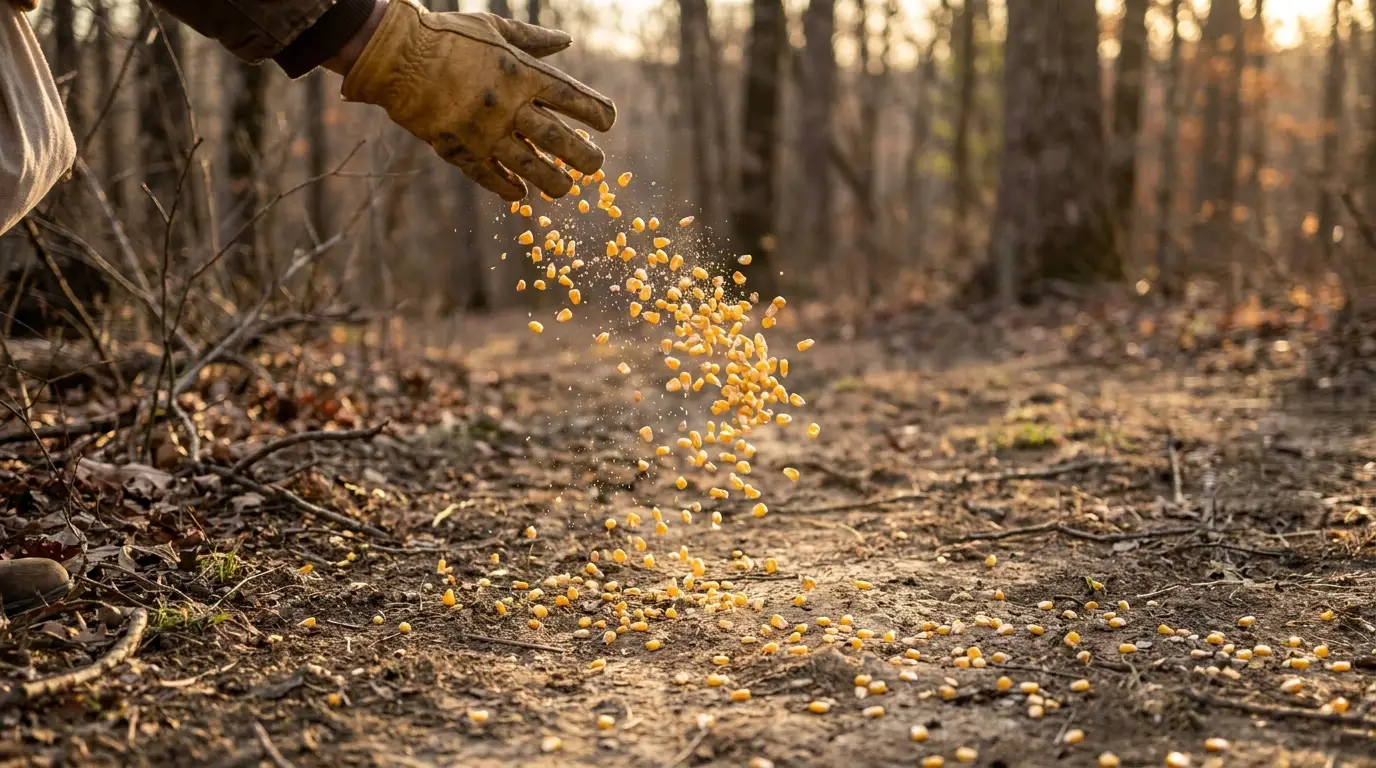
The rules are narrower than the fee headline suggests. TWRA's published bait regulations allow "corn, wheat, grains, natural food substances, or any product exclusively produced or marketed for feeding deer," and exclude "any processed foods or enhanced/modified products not categorized above," naming sugar, honey, syrups, pastries, candies and peanut butter. No more than five gallons or 25 pounds of bait may be available for consumption at a single bait site during any 24-hour period. Bait has to be scattered across the ground rather than piled, open trough style feeders are prohibited, and a property of five acres or less gets one bait site, while larger properties may have one site per five acres and must keep sites at least 500 yards apart.
One clause matters more than the fee. The agency may suspend the baiting privilege, without refund, on a county, regional or statewide basis to prevent disease spread, and it can do so by issuing a news release.
The revenue case was made in writing before the vote. The Fiscal Review Committee's March 14, 2025 memorandum projected $6,511,314 a year to the Wildlife Fund, built on TWRA's estimate of 170,108 deer hunters and a 68 percent uptake rate borrowed from Alabama's bait license program. That works out to 115,673 licenses, or $5,494,450 from residents and $578,400 from nonresidents.
The last $438,464 is the part nobody campaigned on. Tennessee's roughly 20,800 license-exempt landowners cannot be counted toward federal wildlife grant apportionment, and a bait license makes them countable at about $31 each. Apply the same 68 percent uptake assumption to that pool and it is roughly 14,100 landowners buying a credential they have never needed.
Where the Bait Line Is Drawn
Baiting is not legal everywhere in Tennessee, and the map is worth reading before anyone hauls a feeder into a field. Wildlife Management Areas are out. The CWD Management Zone is out, covering Benton, Carroll, Chester, Crockett, Decatur, Dyer, Fayette, Gibson, Hardeman, Hardin, Haywood, Henderson, Henry, Madison, McNairy, Lake, Lauderdale, Obion, Shelby, Tipton and Weakley counties. Every additional CWD-positive county is out too, under a clause that closes a county by detection rather than by name. TWRA's bait regulations page names four of those counties: Dickson, Humphreys, Lewis and Williamson. The agency's separate CWD In Tennessee page is where the positive-county list now runs to 23, and it is that list, not the regulations page, that also closes Wayne County.
Cross-reference the two lists and the practical geography emerges: 26 distinct Tennessee counties are closed to baiting, which leaves 69 of the state's 95 counties open, a little under three-quarters of them. The overlap is imperfect in both directions. Five counties with confirmed positives sit outside the management zone, and three zone counties, Benton, Lake and Obion, have no wild positive detection on record and are closed anyway.
Tennessee has been living with the disease since December 14, 2018, when a diagnostic lab told TWRA that 10 hunter-harvested deer from opening weekend in Hardeman and Fayette counties were positive. More than 100,000 deer have been sampled since.
Two States Went the Other Way
The timing is the story. Tennessee put baiting on sale in the same eighteen months that two other states moved to get feed off the ground, one banning the practice outright and one widening a ban it already had.
Washington detected its first case of chronic wasting disease in 2024, in a white-tailed deer in Spokane County, with additional cases following in Spokane and one in Pend Oreille County during that hunting season. Washington Department of Fish and Wildlife Director Kelly Susewind approved a statewide ban on feeding and baiting deer, elk and moose on March 24, 2025, and the rules took effect May 17, 2025. The prohibition reaches salt blocks, cervid-urine scent lures, and even feeding other wildlife if it causes deer, elk or moose to gather. Washington went from first detection to a statewide bait ban in roughly ten months. Tennessee went from first detection to legal bait in seven and a half years.
Minnesota has no bait license to sell and never has. State law bars the practice everywhere in Minnesota, in one sentence: "A person may not take deer with the aid or use of bait," Minnesota Statute 97B.328 reads.
What Minnesota has been tightening is a separate rule, one that reaches past hunting to the act of putting food out at all, year round. On June 22, 2026 the Minnesota Department of Natural Resources added Becker, Clearwater, Grant, McLeod and Meeker counties to its deer feeding and attractant ban, bringing the total to 37 of the state's 87 counties. "Where people place food or attractants out for deer, higher numbers of deer tend to congregate in one place," said Paul Burr, the department's acting big game program leader. "The feeding and attractant ban is one tool to reduce the unnatural congregating of deer and lower the risk of CWD spread."
So the contrast is not one of degree. Tennessee is selling permission for something Minnesota bans outright, and Minnesota is now going after feed that has nothing to do with a hunt.
The disease argument does not rest on agency preference alone. Prions shed in saliva, urine and feces persist in soil, and researchers who sampled 11 Wisconsin mineral licks inside the CWD outbreak zone detected prions at nine of them (Plummer et al., PLOS ONE, 2018).
The National Deer Association, which does not campaign to repeal baiting where it is already legal, opposes expanding it where disease is present: "The science is clear that baited sites are hotbeds for the accumulation of prions and other infectious materials." TWRA's own July 15 announcement notes that concentrating animals raises transmission risk for CWD, bovine tuberculosis and brucellosis, and that poor-quality or improperly stored grain may carry aflatoxins the agency calls "highly toxic to species like turkeys and quail." "As an agency, though, we've typically been opposed to this," TWRA spokesperson Emily Buck told NewsChannel 9 while the bill was moving.
More than 22 states allow baiting in some form, including five of Tennessee's neighbors: Arkansas, Kentucky, Alabama, Georgia and North Carolina. Hunters near those lines have watched legal corn on the far side of a state boundary for years. "A lot of other states allow hunting over bait anyway, like Texas and several other states, so that's my reason for supporting it," Hensley told Outdoor Life. "I just don't think that people should be penalized because they're hunting over bait, especially on their property." Tennessee hunter Lance Redden made the practical version of the same point to NewsChannel 9: "People put food plots out every year. I mean, that's basically the same thing as baiting."
That equivalence is what biologists contest hardest. Kip Adams, a certified wildlife biologist and the National Deer Association's chief conservation officer, has written that "food plots spread deer out over a much larger area than bait sites, and thus they mimic natural forage in woods and fields," which "reduces direct contact with individuals thus reducing possible transmission of diseases and parasites." Bait sites, he writes, "tend to congregate animals in a very small area which exacerbates stress, aggression, exclusion, disease transmission, and habitat degradation."
The empirical version of the pro-baiting case has named advocates too. Richard P. Smith, a Michigan outdoor writer who has been reporting on whitetail behavior and biology for decades, wrote in a Deer & Deer Hunting column that bans buy the appearance of action and little else, putting his own time in the woods at that point at close to 30 years: "I've walked with whitetails of both sexes and all age classes for close to 30 years and I can assure you whitetails have close social, nose-to-nose contact whether or not baiting is legal." Then-state Rep. Beau LaFave, who left the Michigan House in 2023, made the blunt version of the point when the Upper Peninsula came under a feeding ban, telling WLUC at the time that there is "zero scientific evidence to prove that banning baiting or feeding does anything whatsoever." Both men were arguing about Michigan rules, years before Washington and Minnesota wrote the ones in this story.
The Wisconsin mineral-lick paper does not close that gap. It detected prions at nine of 11 licks. It did not measure whether prohibiting bait changes infection rates in a herd.
Public Chapter 444 does not spare the landowners it was written for. Tennesseans who have never needed a hunting license to hunt their own ground still owe $50 to put corn on it, and for a leased property, the license belongs to the hunter, not the ground, so every member of a lease party who hunts over bait buys their own.
For anyone who leases Tennessee ground, the change is contractual before it is tactical. A property in one of the 69 open counties can lawfully host baited hunts starting August 1, 2026, but the license follows the hunter rather than the acreage, and everyone in a party hunting over bait needs one. So the questions a lease should answer are specific: whether bait is permitted at all, who buys the licenses, where feeders may sit, what bait and how much, and who hauls the leftovers out. TWRA can pull the privilege by news release with no refund, so a lease sold on the strength of baiting can lose that feature mid-season. Wherever the property sits, the rules that actually govern are TWRA's county list and the agreement itself.
The number to watch is 68 percent. That Alabama-derived assumption is the entire revenue projection, and by winter TWRA will know how many of the projected 115,673 licenses Tennessee hunters actually bought.