 Written by HLRBO Staff|
Last updated
Public land is an incredible resource for hunters, but it’s not distributed evenly around the country. The West generally has much more public land than Eastern states, but not always. For this article, we mined government and HLRBO user data to dive into the numbers (and found some surprises along the way).
While the Mountain West states dominate the top of the list for acreage of public land per hunter as expected, a surprise was that several Midwestern states show up on the Bottom 10. They fare worse than small, high-population states on the Eastern seaboard.
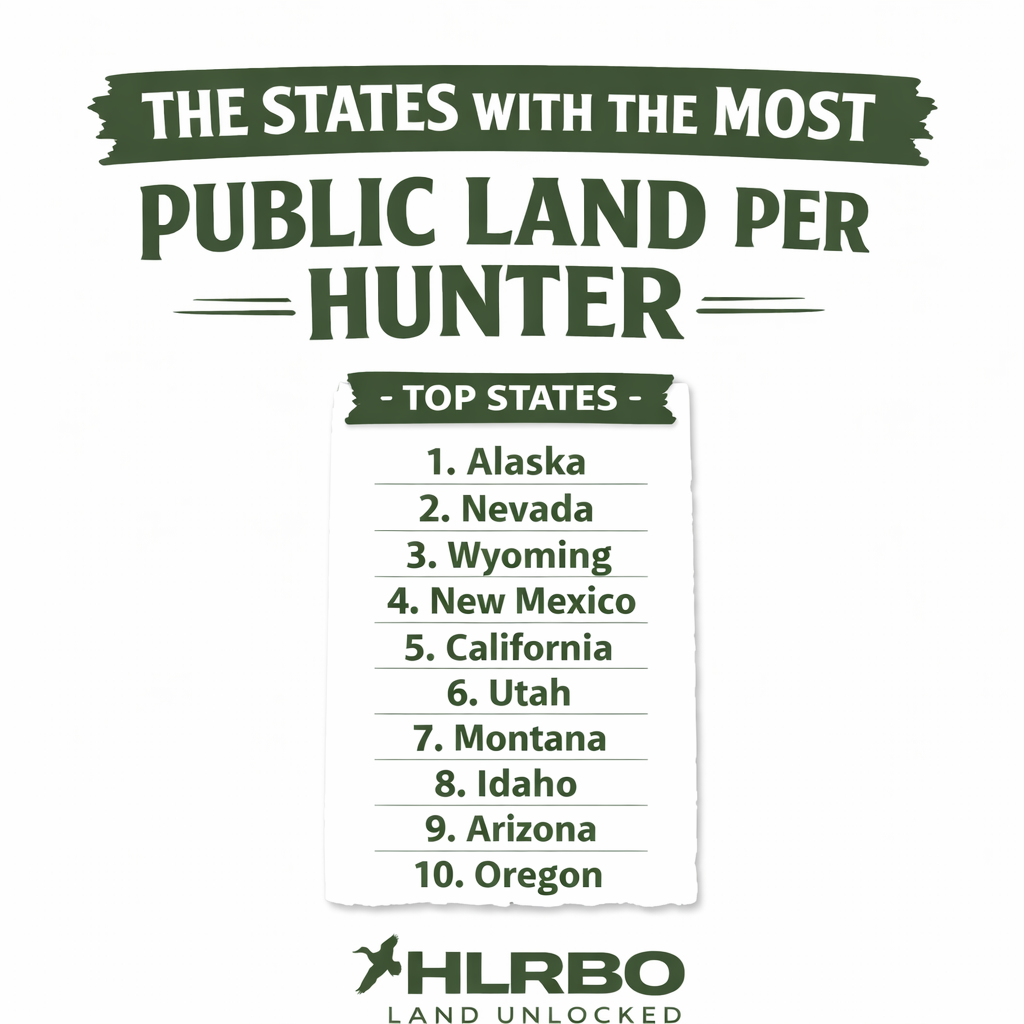
As revealed above, the states with the most public land per hunter are Alaska, Nevada, Wyoming, New Mexico, California, Utah, Montana, Idaho, Arizona, and Oregon.
Not surprisingly, Alaska, with a low population and 271 million acres of public land, leads this list. Few of the other states are shockers, with large Western states making up the rest of the top 10.
California is perhaps a surprise given the high population. But most of those people are non-hunting urbanites and the numbers show that there’s plenty of public land to go around for those that do hunt the Golden State.
(Note: “Hunter” here is defined as a license sold in the state, not a single individual. This accounts for hunters that apply for licenses in multiple states and accounts better for total hunting pressure on a state and the distribution of public land to those hunters. We used U.S. Fish and Wildlife data from 2023.)
The States with the Least Public Land Per Hunter
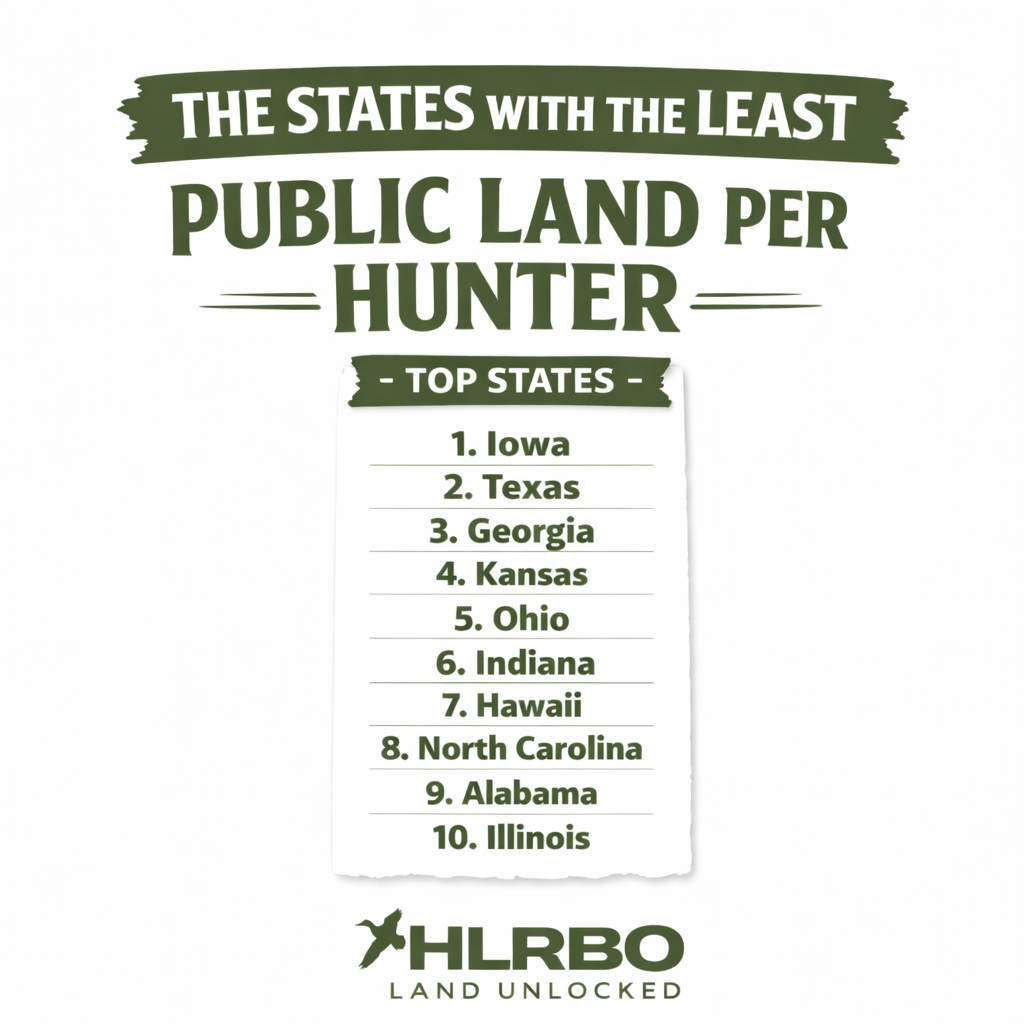
States with the least public land per hunter are Iowa, Texas, Georgia, Kansas, Ohio, Indiana, Hawaii, North Carolina, Alabama, and Illinois.
Texas is famous for its massive expanses (second only to Alaska), but it has very little public land. Other entrants are surprising if you haven’t seen the data before. Iowa, Kansas, Illinois, and Ohio are sought-after whitetail destinations, but not nearly as population-dense as Eastern states such as NY (25th) and Virginia (21st), for example, which fall right in the middle of our list.
Why Do Some States Have More Public Land Than Others?
During Westward expansion over a century ago, wilderness preservation via National Parks and other designations hadn't become commonplace. In the 20th Century, the conservation movement took off, but by this point, the original 13 colonies and other states in the East had been developed and land was under private ownership.
By contrast, the West was sparsely settled and the rugged mountains and harsh deserts were prime candidates for conservation as public lands since they weren't in demand for agriculture. (To learn more about how public lands became an uniquely American project, check out Wilderness and the American Mind by Roderick Nash.)
Not All Public Lands are Created Equal
Western states often have huge totals of public land on paper, sometimes more than 50% of their total acreage, but that doesn't always translate to high hunting opportunities. Nevada, for example, has 56 million acres of public lands, but much of that is inhospitable desert with low game density.
For example, in Wyoming (and several other states) where there are few people, tons of public land, and lots of game animals, the checkerboard pattern of land ownership makes a lot of that public land inaccessible.
Even if you primarily hunt public land, private land access can be a key tool for hunters. In states where public land is sparse, land leasing through sites such as HLRBO offer access to land.
Not surprisingly, HLRBO has a strong presence in these low-public-land states and the platform regularly adds new listings to help meet the demand for places to hunt.