 Written by Justin Park|
Last updated
Should you be afraid of other hunters? Most seasoned hunters don’t spend their time in the woods in fear of being shot. But new hunters and non-hunting hikers often spend the fall looking over their shoulder and ducking at any loud noise.
These groups aren’t as familiar with the reality of hunting and are often more intimidated by guns, so, like infrequent ocean-goers terrified of sharks, they overestimate the danger.
Still, there’s a non-zero chance you could be injured or killed in a hunting accident, and it’s worth reviewing the statistics to understand the most common dangers and ways to avoid becoming one of those stats.
Am I Going to Get Shot?
When I was duck hunting once, I had a miffed kayaker ask me if I was going to shoot her because she would be out on the water. I quipped that, luckily for her, I wasn’t hunting kayakers that day.
Unfortunately for perceptions of hunting (and those that get shot), there are cases each year of people mistakenly shot and sometimes killed in hunting accidents. The victims are most frequently hunters themselves.
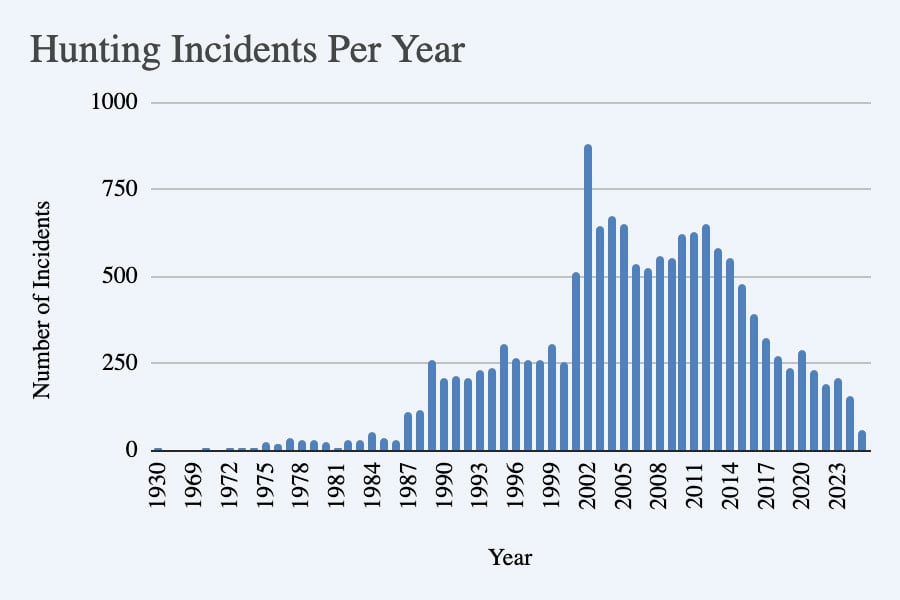
The International Hunter Education Association maintains a database of hunting incidents in the U.S. dating back to 1974. It contains record of thousands of hunting accidents from the past 50 hunting seasons, and about 10% of those accidents were fatal.
A scholarly review of firearm injury data from hospitals from 1993 to 2007 found a higher number: There are about 2,400 ER visits per year related to hunting, with 0.6% ending in death.
Whichever database you look at, the odds of injury or death from hunting are low when you consider that there are around 15 million hunters in the United States. In 2018, the National Shooting Sports Foundation compared injury rates in hunting to other sports such as softball and tennis and found lower injury rates for hunting than all sports except for billiards.
Avoiding Tragedy
Still, the IHEA database has hundreds of instances of fatal hunting accidents involving firearms. The most common cause of death in these instances was “failure to properly identify target” before shooting, such as this heartbreaking case report from one such instance in Florida in 1989:
“A father (the shooter) and his son were hunting in the east entrance to the Eureka boat ramp sitting in their van. The shooter observed what he believed to be a deer in the dense swamp area. The shooter then exited the vehicle and observed through a scope what he thought was the deer. He fired one shot from his 22-250 rifle. The bullet struck the victim in the back of the head exiting the face. The victim was sitting in front of his grandfather on a downed palm tree.”
Always follow firearm safety basics and stay calm in the field no matter how exciting a hunt, and take time to properly identify your target. Following the four basic rules of firearm safety would have prevented nearly all of the firearm-related incidents in the IHEA database.
- Always Keep Firearm Pointed in a Safe Direction
- Treat All Guns as Though They are Loaded
- Keep Your Finger Off the Trigger until You are Ready to Shoot
- Always Be Sure of Your Target and What’s Beyond It
If you feel confident in your hunting safety practices, but are concerned about other, more reckless hunters, consider finding exclusive access to private land. The HLRBO platform can help you search for hunting leases in your area, the majority of which will limit access to you and your hunting party.
Beware the Trees
Accidents have decreased substantially since hunter education requirements were implemented across most states in the second half of the 20th Century. In the 2020s, the greater danger by far for hunters is tree stands.
The Minnesota DNR reports that hunting accidents declined from 264 in 1967 (the year before hunter education began in the state) to 11 in 2023. But it concedes that 1 in 3 tree stand hunters will suffer an injury from a fall in their hunting lifetime.
Yes, poorly built tree stands, lack of sleep, and other factors can cause falls, but the use of a harness-based Fall Arrest System is the easiest way to prevent falls and reduce the severity of injuries.
The Takeaway
Hunting remains one of the safest outdoor pursuits when compared with other sports, but the risks are real. Firearm accidents usually come down to a lapse in target identification or basic safety rules, while the greatest threat today is falling from a tree stand.
With hunter education, proper gear, and disciplined safety practices, both new and seasoned hunters can keep the tradition alive without adding to the statistics.
AUTHOR BIO: Justin Park is a Colorado-based writer, editor, and avid hunter with a passion for the outdoors. He contributes to leading publications such as GearJunkie, Popular Mechanics, Powder, and Men's Journal, and serves as Editor of Wild Snow. Park is deeply involved in conservation and recreation advocacy, serving as Chapter Chair of the Rocky Mountain Elk Foundation (RMEF) in Summit County. He also represents RMEF on a state recreation committee focused on proactively addressing land use conflicts.