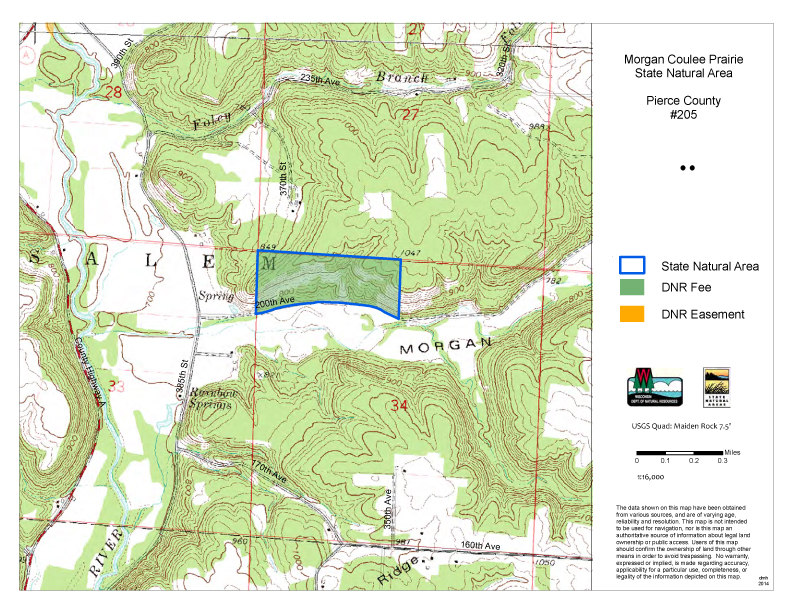
The second largest dry prairie in the west central region, Morgan Coulee Prairie extends for over a half-mile along a steep, south-facing bluff in a coulee opening onto the Rush River valley. The large expanse of relatively undisturbed dry prairie is broken up with scattered islands of bur oak savanna dominated by open grown, gnarly oaks and shallow wooded draws. Limestone outcrops are scattered about the area and support a community of lichens and ferns. Dominant grasses include big and little blue-stem, side-oats and hairy grama, Indian grass, needle grass, prairie drop-seed, and several muhly grasses. The forbs are equally diverse, highlighted by showy species such as asters, milkweeds, white and purple prairie-clover, blazing-star, Great Plains lady’s-tresses, and prairie larkspur. Wild bergamot, bastard-toadflax, and western sunflower are found under the oaks. The prairie also harbors two rare plant species: yellow evening primrose (Calylophus serrulatus) and prairie thistle (Cirsium hillii). Much of the prairie is remarkably free of shrubs; those present include hazelnut, bittersweet, smooth sumac, and dogwoods. At the bluff is a southern dry oak forest. Animal species of concern include eastern bluebird (Siala sialis), field sparrow (Spizella pusilla), and Reakert’s blue butterfly (Hemiargus isola). Morgan Coulee Prairie is owned by the DNR and was designated a State Natural Area in 1986.