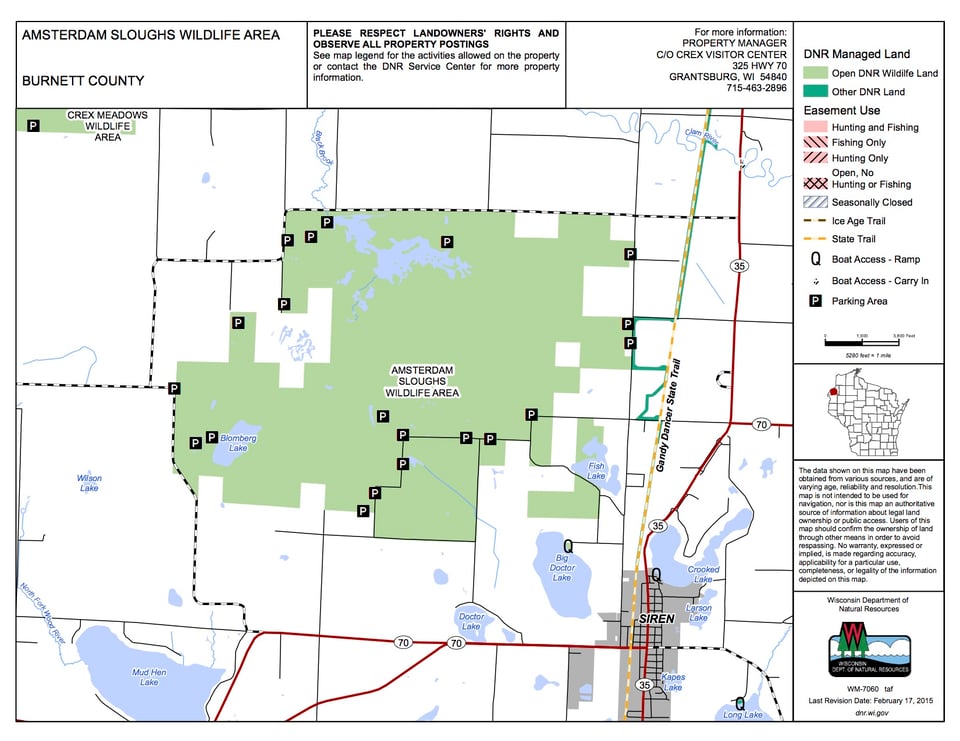
From glacial ice to today's landscape, Amsterdam Sloughs Wildlife Area has a rich history.
The ground you walk on was once the bottom of a huge glacial lake which occupied this area about 10,000 years ago. That's why the soil is so light and sandy. Out of this soil grew a brush-prairie. Imagine a landscape with a few large red and jack pine trees scattered amidst a prairie of scrub oak, hazel, sweet fern and colorful prairie grasses and woody plants. Massive sedge marshes broke up the landscape.
Wildfires maintained the brush-prairie for thousands of years. Heavier soils, in what is now the southeast portion of the wildlife area, supported a northern hardwood forest of maple, oak, ash, birch and aspen. Wildlife flourished within this diverse environment.
Change came when white settlers arrived during the late 1800s to farm the sandy land. While farming proved futile, it broke up the prairie and suppressed wildfires. Without fire, the original brush-prairie grew into a jack pine and oak forest. In addition, wetlands were being drained at a rapid rate; by the early 1900s nearly all the wetlands were drained. These major changes caused many native wildlife species to decline or completely disappear.
Acquisition for Amsterdam Sloughs began in 1956. Currently the project boundaries include 7,233 acres (over 80 percent state ownership). There is some private land within the boundary - watch for posted land.