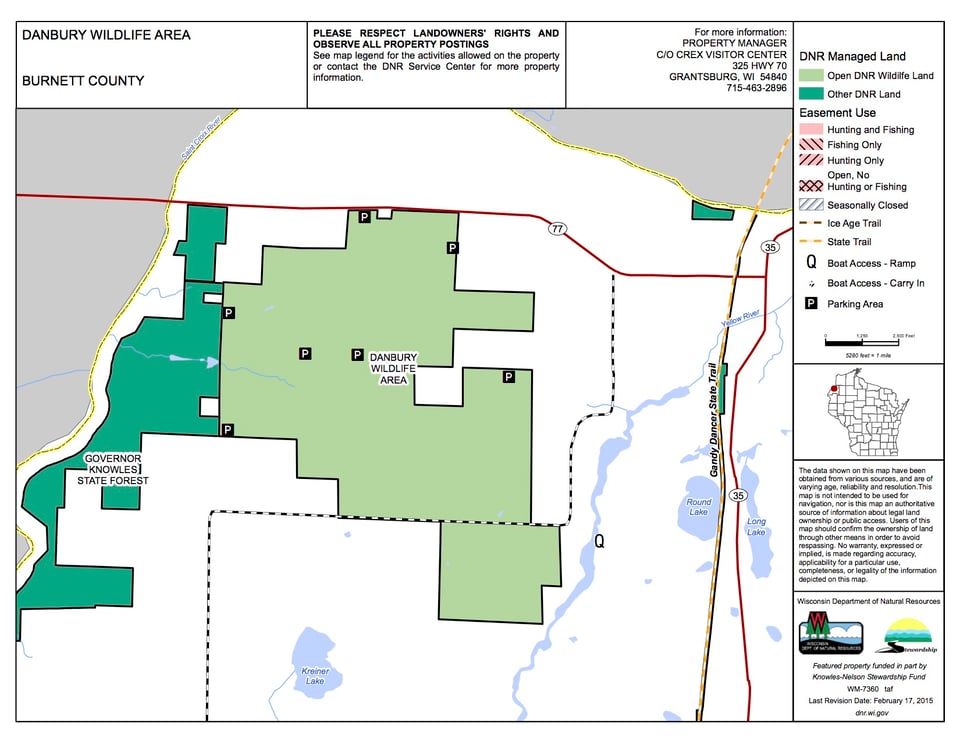
Danbury Wildlife Area is one of four properties comprising the Glacial lake Grantsburg Work Unit. It occupies a portion of the Northwest Wisconsin pine barrens. Historically, wild fires were common in these barrens and this kept the landscape in a relatively open condition. Prior to settlement, the barrens were covered by scattered jack and red pine, oak (mostly sprouts), and prairie grasses and forbs. Numerous shallow marshes are scattered throughout the region.
During settlement in the late 1800s much of the region was farmed. However, the sandy soil was marginal farm land and most farms were soon abandoned. Much of the land became tax delinquent and reverted to county ownership. The wildlife area originated in 1956 when 1,233 acres of tax delinquent land were leased from Burnett County. In 1968 the State purchased 1,202 acres from the county for $8.04 per acre. The original project acreage goal was 2,039 acres. A boundary expansion in 1973 increased the acreage goal to the current level of 2,866 acres. The wildlife area currently has 2,244 acres State ownership.
Danbury Wildlife Area consists of a 450 acre shallow marsh interspersed with aspen islands and surrounded by aspen, oak, jackpine forests, and agricultural fields. The lowland forests are dominated by trembling aspen with scattered swamp hardwoods and swamp conifers. The drier sandy sites contain vegetation typical of the original pine barrens. In the absence of fire, these sites have grown into oak-jackpine forests. Both scrub (Hill's Oak) and bur oak are common. Large red and white pine are scattered throughout the property. Grassy openings are dominated by prairie grasses and forbs. The shallow marshes are dominated by sedges, cattail and leatherleaf with an overstory of tag alder and willow.
A variety of resident and migratory wildlife use the area. Resident game species include white-tailed deer, black bear, snowshoe hare, ruffed grouse, woodcock, gray squirrel, beaver, mink, and otter. Woodcock, snipe, and several species of ducks are the principal migratory game species using the area. The property is used by many nongame bird species including bald eagle, great blue herron, sedge wren, American bittern, sora rail, and a large variety of song birds.