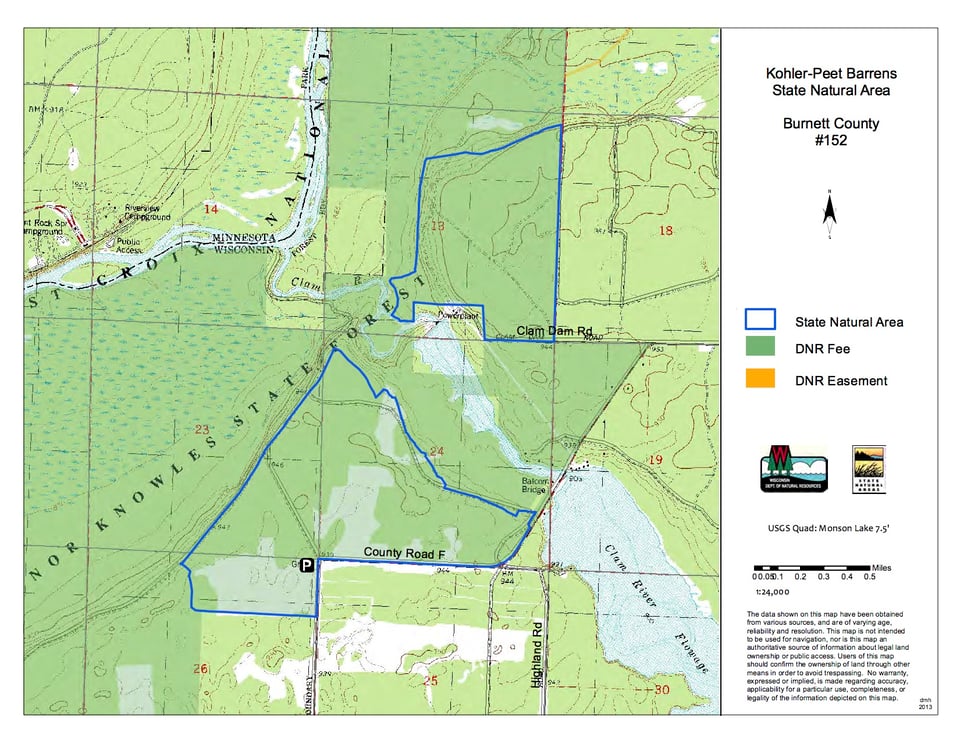
Kohler-Peet Barrens is a nearly flat expanse of sandy, open barrens situated within the vast glacial outwash deposits of northwestern Wisconsin and adjacent to the steep-walled St. Croix River Valley. Historically, this region supported Pine Barrens vegetation, which burned repeatedly. Today Hill's oak grubs, jack pine, quaking aspen, and pin cherry are the common trees and many of the oaks have multiple trunks and bushy sprouts, the result of prescribed burning used to maintain the open barrens. The barrens flora is diverse with many species of prairies, barrens, and bracken grassland communities. Four plant species with Great Plains distribution - blue giant hyssop (Agastache foeniculum), autumn onion (Allium stellatum), Carolina larkspur (Delphinium carolinianum) and hairy four-o'clock (Mirabilis hirsuta) - are found here at their northeastern range limit. Common shrub species include beaked and American hazelnut, New Jersey tea, and prairie red-root. Many rare and uncommon animals of open habitats are found here including the federally endangered Karner blue butterfly (Lycaeides melissa samuelis), sharp-tailed grouse (Tympanuchus phasianellus), eastern bluebird, vesper sparrow, and field sparrow. Kohler-Peet Barrens is owned by the DNR and was designated a State Natural Area in 1979.