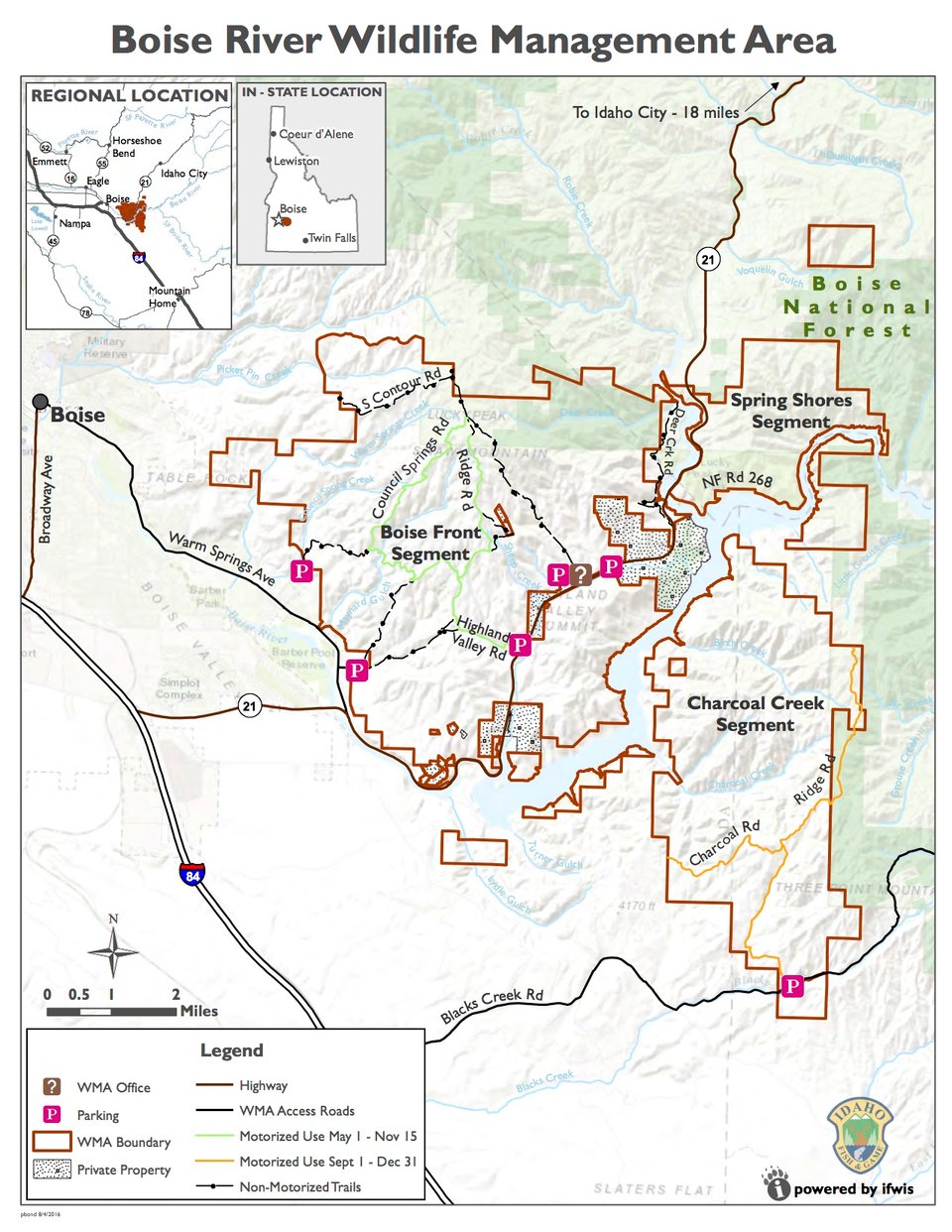
The Boise front segment of the WMA is just east of the city of Boise in southwest Idaho’s Ada County.
From Interstate 84, take exit 57 and travel 15 miles northeast on State Highway 21, past Lucky Peak Lake.
Just after cresting the Highland Valley Summit, look for the Boise River WMA headquarters sign at mile marker 15.
Over 7,000 mule deer and nearly 500 elk spend the winter months on the WMA, browsing, resting and waiting out the long, cold winter season. During other seasons, both species are much less numerous.
Bald and golden eagles are seen throughout the year, though their concentrations tend to increase during winter months. Goshawks, Cooper’s hawks and sharp-shinned hawks frequent the Douglas-fir and ponderosa pine forests. Red-tailed hawks, northern harriers and American kestrels are common spring, summer and fall residents of open country.
Gopher snakes, western rattlesnakes, rubber boas and sagebrush lizards are found throughout the area.
Big game, upland bird and small game hunting are all available on Boise River WMA lands.
Herds of mule deer, elk and pronghorn winter on the WMA attract wildlife enthusiasts, an attraction that can prove fatal to these big game species. Winter is a difficult time for them. Forage is often at a premium, and winter temperatures, wind and snowfall tax their already limited energy reserves. Human disturbance can be extremely harmful to big game animals during this period, in some cases causing death or loss of fetuses.
For this reason, some areas within Boise River WMA are closed to the public during winter.