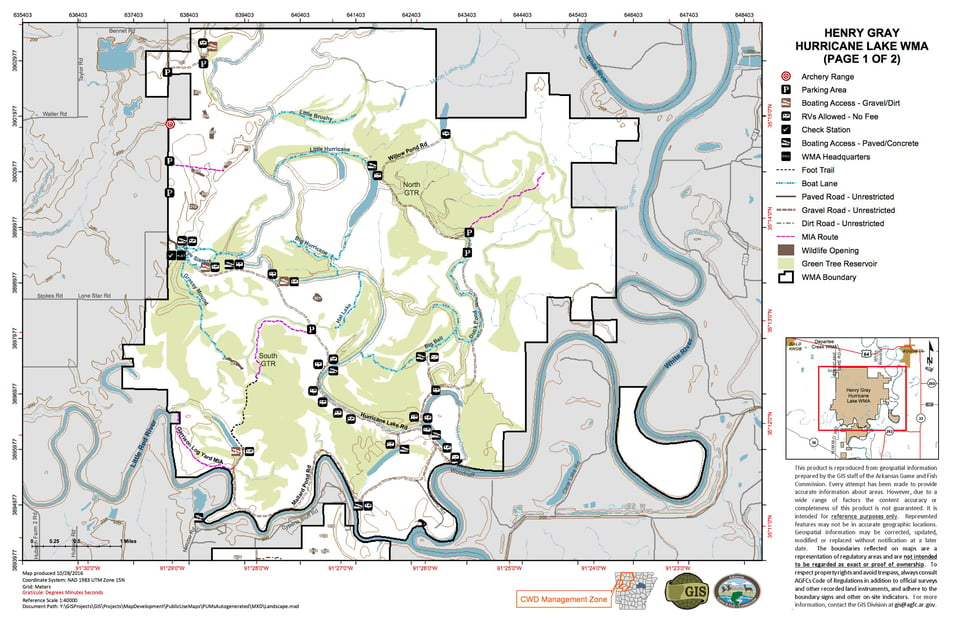
The area consists of 17,000 acres of prime bottomland hardwoods habitat. The area has numerous sloughs and flats throughout and several ridges. Elevation ranges from 190 to 210 feet above sea level. The White River bound the WMA on the east and the Little Red River separates approximately 4,000 acres from the main body of the acreage. Glaise Creek is another main tributary located on the area. The WMA also has several oxbow lakes, the main ones being, Big Hurricane, Little Hurricane, Big Bell, Little Bell, Whirl lake, honey Lake, Big Brushy and Mallard Pond.
Fishing opportunities and hunting and camping use make this WMA one of the most heavily used WMA’s in the state. It is the third-largest state-owned management area.
Access can be gained by taking US highway 64 east from Bald Knob for 5 miles, where one will see the Henry Gray/Hurricane Lake WMA road sign. Turn right at this sign onto the county road, stay on this road for 4 miles and it WILL enter directly into the area.
Access to the south side of the area can be gained by taking state highway 36 east from Searcy to Georgetown. This highway will run through part of the area approximately 1 mile east of Georgetown. Access can also be gained by turning left on the gravel county road approximately 10 miles east of Searcy at the Georgetown water tower, where Nimmo Access sign is located. Follow this road for approximately 3 miles, take the first gravel road to the right, and follow 1 mile to camping area and WMA boundary.
Hunting for black bear and turkey is closed on this WMA, with the exception of permit youth hunt for turkey.
Deer -- there is an increasing population and the opportunity to harvest a bragging size buck is better than average. Gun and muzzleloader hunts are by permit only, but archery and crossbow seasons are the same as statewide.
Waterfowl -- this area has several water control structures put in place to manage water for wintering waterfowl. Hunting is usually good if the right water conditions exist.
Small Game -- Cottontail rabbit and squirrel populations tend to fluctuate somewhat. Generally there is a good population of each about every 3 years. Swamp rabbit hunting is better than average but also tends to be cyclical.
Quail -It is classified as poor. The opportunity to do extensive quail management on this area just does not exist.
Furbearers, raccoons and mink are the main furbearers sought after on this area. The season and regulations are the same as statewide. Hunting and trapping are both legal. Check WMA regulations pamphlet for particulars on hunting and trapping of furbearers on that part of the area designated as waterfowl rest areas.