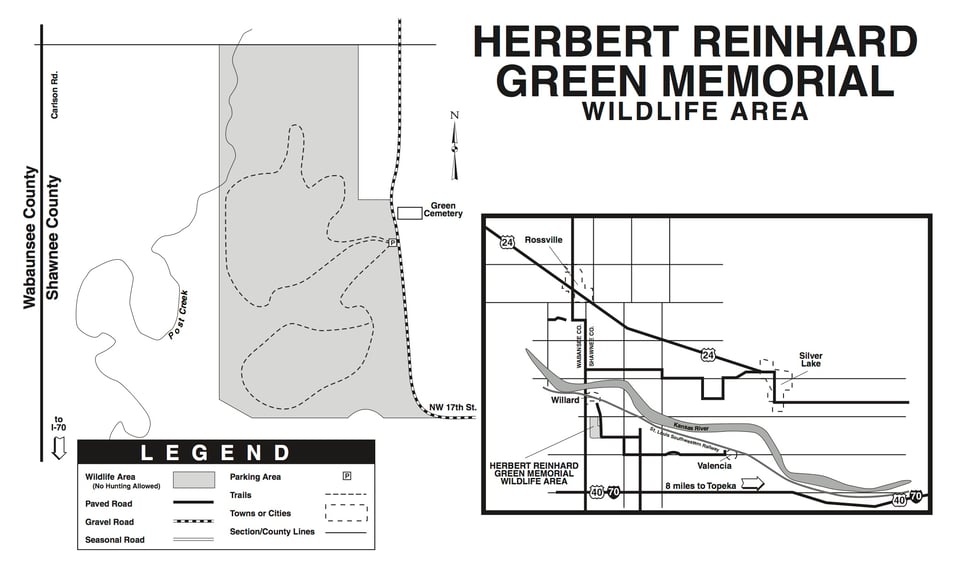
The area contains several diverse ecosystems. Post Creek, running through the western boundary, is an example of an eastern Kansas stream and its associated riparian vegetation. Eastern deciduous oak-hickory woodlands are found on the northern end, while examples of native tall grass prairie containing native warm season grasses and forbs can be found on the eastern edge. Principal management techniques include prescribed burning and selective cutting of invasive woody vegetation.
This area is very rich in history. The town of Uniontown was established in this area, and was once the largest city in Kansas before Kansas was even a territory. Uniontown was an important stop for settlers traveling the Oregon-California and Leavenworth to Pikes Peak trails. Several trails converged here because of a natural rock ford in the Kansas River. Prior to European settlement the Pottawatomie Indians lived in this area, and in 1848 a Pottawatomie Indian trading post was erected here. Cholera outbreaks in the area killed the Pottawatomie Indians by the hundreds and many settlers. The town was abandoned and burned in 1849 due to the threat of cholera. However, in 1850, Uniontown was rebuilt because of its importance as a trading post and also because a ferry had begun operation at the Kansas River crossing. In 1854, when Kansas became a territory, new towns sprang up in the area which outcompeted Uniontown for trade. Uniontown was abandoned by 1855, and in 1859, the remains of the town were burned. Today all that remains of Uniontown is a small country cemetery where mass graves of cholera victims are buried along with those who settled in this area.
The Green Family settled and began farming the land where the wildife area is today. They farmed here from the 1870's until the 1960's. At the entrance of the wildlife area a small cemetery has several early cholera victims buried there. Ruts from the Oregan trail are still visible along the Oregan Trace nature trail.