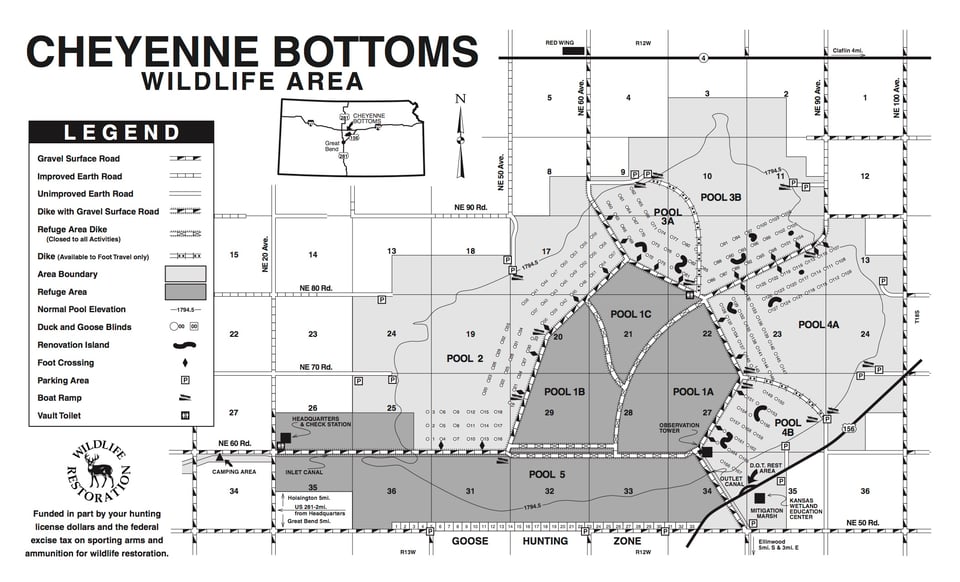
The 19,857-acre Cheyenne Bottoms Wildlife Area is part of a 41,000-acre natural land sink just northeast of Great Bend.
During the 1940's and1950s, the State of Kansas acquired the land, and dikes were constructed to impound water in five pools. Canals and dams were built to divert water from the nearby Arkansas River and Wet Walnut Creek to supplement water provided by two intermittent streams, Blood and Deception creeks. Monies for this initial land purchasing and development came from two sources. One was the sale of hunting licenses. The second was from a Federal excise tax on sporting arms and ammunition. The Federal Aid in Wildlife Restoration Act was passed in 1937. This legislation allows for the collection of this excise tax money which is then apportioned out to each state with the amount received based on the total area of the state and the number of hunting licenses sold. The program is a cost reimbursement program where the state covers the full amount of an approved project then applies for reimbursement through Federal Aid for up to 75% of the project expenses. Cheyenne Bottoms was one of the first projects the State of Kansas embarked on using this Federal program. Federal Aid continues to fund, along with hunting license dollars, the annual operation and maintenance of the property for all to enjoy. Some of the best wildlife viewing opportunities can be had on land bought and maintained using these hunter generated dollars.
During the 1990s, extensive renovation sub-divided some of the pools. In addition, pump stations were built to allow for increased management flexibility and water level manipulation. This renovation effort also provided increased water conservation to better meet wildlife needs during dry periods. Manipulation of water levels in the pools is a major tool in managing the marsh for water birds. Another part of the renovation was the construction of large (2 to 5 acre) islands in Pools 3 and 4. These islands served as locations to deposit accumulated silt in areas of chronic cattail stands. They also are used by hunters and nesting birds.
Each year, one or more of the pools is drained as deemed necessary. Often these areas are seeded to millet and/or wheat and undesirable vegetation is controlled by burning, mowing and disking while the pools are dry. The photo below shows the current plant that is posing a threat to Cheyenne Bottoms. Phragmites is a wetland plant that, if left unchecked, can take over a marsh. It has even out competed cattail at Cheyenne Bottoms.
Hunting pressure on the Bottoms can be heavy during waterfowl season, particularly on weekends. Hunters planning trips to the Bottoms should consider weekday hunts.
Prior to hunting any species on Cheyenne Bottoms Wildlife Area, all hunters are required to obtain and complete a Daily Hunt Permit. These permits can be found at all entrances to the wildlife area, at all parking lots and most boat ramps. Silver colored, iron dispensers are located at these points. Each permit is a two piece card. Before hunting, complete the top portion of the card and separate it from the lower portion and place it in the permit box. Carry the lower portion of the permit with you while hunting. Upon completion of your hunt, fill out the lower portion and place it in a permit box. Each hunter must complete one for each day hunting at Cheyenne Bottoms. Hunters are encouraged to use iSportsman, the electronic Daily Hunt Permit. First time users will need to register and obtain a General Access Permit. Registration can be done any time prior to the first hunt by logging on to https://kdwpt.isportsman.net click registration. Once you have obtained the General Access Permit you can log in from a computer or smart phone or call 1-844-500-0825 to 'check-in'. Once checked in you are ready to hunt. After you are done hunting for the day, 'check-out' the same way.
Pools 1, 5 and a portion of Pool 2 are refuge areas and closed to all activities. Exceptions to this occur for some special hunts. Check with wildlife area personnel for more information.
In addition to waterfowl, other game may be legally taken at Cheyenne Bottoms. Pheasant hunting is usually good. Snipe and rail hunting is good along the shallow marsh margins. Quail and deer are also present in fair numbers.
A handicapped accessible hunting/photo blind is available by reservation. Call the office for additional information and reservations.
In the event of whooping crane activity, the pool the birds are in is closed to all hunting and the goose hunting zones are closed to crane and light goose hunting.