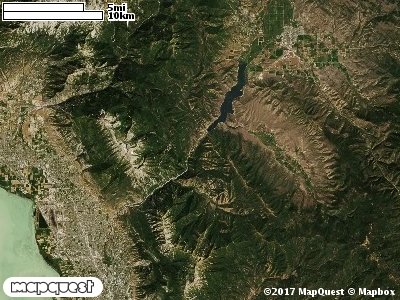
The Deer Creek CWMA is south of the Deer Creek Reservoir and east of State Road 189. The
high point of the Unit is northwest extention of the Wallsburg Ridge (8500 feet). This high drops
off in a west, northwest, north and northeast directions to a low of about 5500 feet. Beginning in
the west Bear Canyon (5500 to 7500 feet), Sunday Canyon (5600 to 7300 feet), Hanks (5600 to
7100 feet) and Sams (7500 to 5600 feet) Canyons are the main drainages that drop away from
the high point.
The Rocky Mountain Gambel Oak-Mixed Montane Shrubland (41) is the donminant land cover
type on the Deer Creek Cooperative Wildlife Management Unit (CWMU), over fifty percent (50%).
Rocky Mountain Bigtooth Maple Ravine Woodland (23) and Rocky Mountain Aspen Forest and Woodland (22) show patches over the Gambel Oak-Mixed Montane Shrubland. There is a
large patch of Inter-Mountain Basins Montane Sagebrush Steppe (62) in the south-central, and
a large patch of Inter-Mountain Basins Big Sagebrush Shrubland (48) in the northeast.
One of the Deer Creek Cooperative Wildlife Mangement Unit (CWMU) nearest weather stations, DEER CREEK DAM (422057), is 0.5 mile west of the west edge of the CWMU. DEER CREEK DAM has forthy-nine (49) years of records, 1959 - 2008. During the FALL (September, October and November) the average precipitation is 2.54 inches, but it can be as high as 7.69 inches or as low as 0.60 inch. During the 91-day FALL period, 15 days will experience greater than or equal to 0.01 inch of precipitation, 8 days of greater than or equal to 0.10 inch, or 1 day of the greater than or equal to 0.50 inch of precipitation. Snowfall during the FALL averages 4.4 inches but can be as high as 30.0 inches. FALL temperature at DEER CREEK DAM averages 46°F. but can be as high as 97°F. or as low as -12°F. During the FALL, 54 days will be below freezing (32°F.) and 1 day above 90°F.