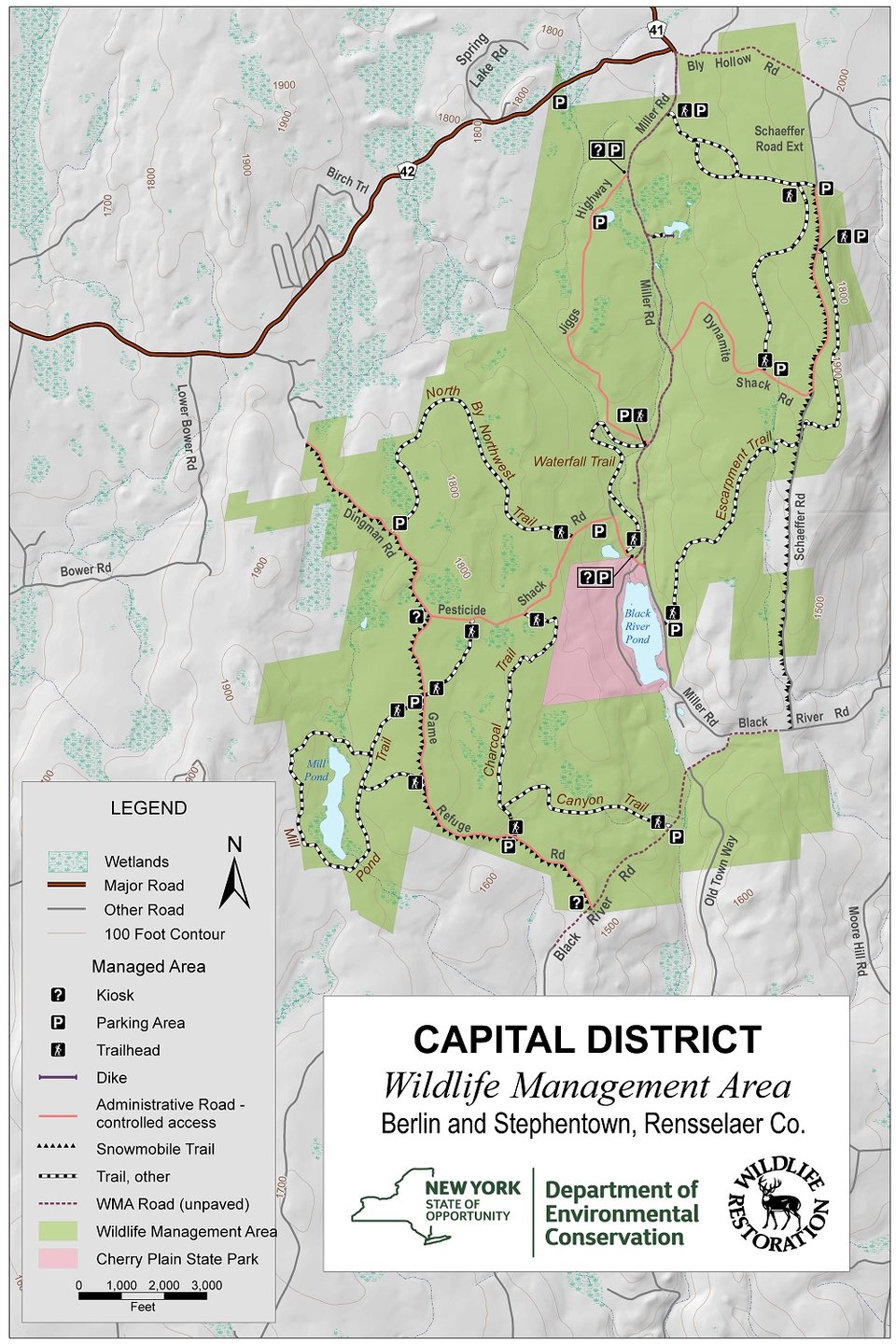
The primary purposes of Capital District Wildlife Management Area (WMA) are for wildlife management, wildlife habitat management, and wildlife-dependent recreation. This WMA is a 4,153 acre parcel acquired from 1928 to 1941 for use as a game management area and game refuge. Prior to acquisition, the main human activities on the area had been subsistence farming and charcoal burning. During the 1930s and 1940s a Civilian Conservation Corps Camp was operated at the WMA and many projects, including the dam for the Black River Pond and the roads on the management area were completed. The WMA was used as a stocking site during the beaver reintroduction program of the 1930s. In 1944 the refuge designation was dropped, and the entire area became a wildlife management area. Capital District WMA is situated at the southern end of a geologic feature known as the Rensselaer Plateau and is covered with semi-mature to mature stands of black cherry, sugar maple, yellow birch, hemlock, red oak, and red spruce. Black spruce, tamarack, and balsam fir occur in the characteristic bog-like wetlands on the WMA. The topography is quite flat, except on the eastern edge which drops into the Kinderhook Creek valley.