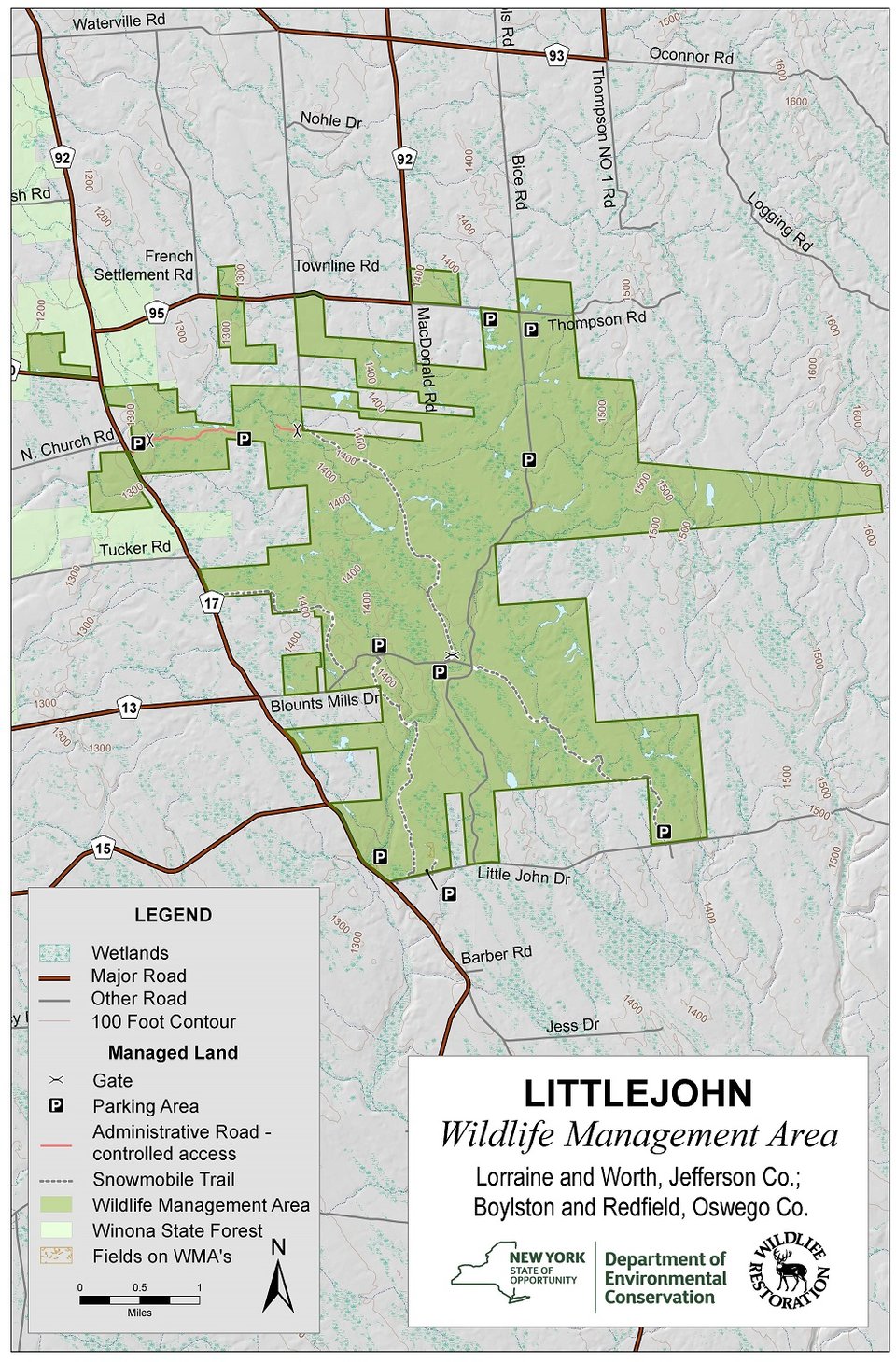
The primary purposes of Little John Wildlife Management Area (WMA) are for wildlife management, wildlife habitat management, and wildlife-dependent recreation.
This WMA totals 7,918 acres. About 60 percent of the WMA is in mature forest with less than two hundred acres in openings such as open water or grassy/brushy fields.
Little John lies on the northwest slope of the Tug Hill Plateau. Most of the area lies between 1,400 and 1,500 feet above sea level. The result is a gently rolling topography,
which is never quite flat transected by many long, narrow serpentine swampy areas and numerous small depressions. The soils are generally acid in nature, being derived from shale and sandstone.
Precipitation ranges between 45 and 55 inches per year with an average annual snowfall above 170 inches. Drifts as deep as 15 feet are common occurrences, and snow lies five to six feet deep in the
woods during an average winter.
In 1928, 4250 acres belonging to the Cleveland Estate became the Little John Game Refugee and Demonstration Forest. Acquisition of abandoned land adjacent to the WMA by the Federal Resettlement
Administrator became part of Little John when it was later transferred to the State.