Driving DirectionsFrom Garwood, take Highway 34 east, then take the Route HH spur.
HighlightsWebb Creek flows through this forest area, which lies to the south of Clearwater Lake. Natural features of interest include two fens, a rhyolite knob, a sinkhole pond, and a dry sink.
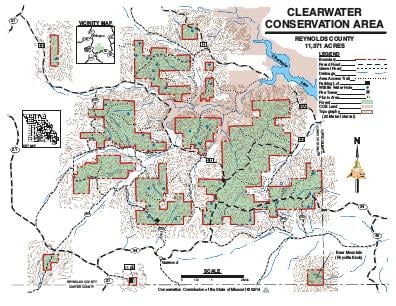
About This AreaClearwater Conservation Area lies southwest of Clearwater Lake in Reynolds County. This area is made up of what used to be known as Webb Creek State Forest and Clearwater State Forest. Access is from Route H, Route HH, Highway 34, and Highway 21. The area is composed of several scattered tracts that are separated by privately owned properties.Much of the forest was harvested around the turn-of-the-century, resulting in the ridges and easily accessible areas containing primarily pole-size timber. However, high quality timber remains in the steeper hollows and draws. Wildlife watering holes are scattered throughout the larger tracts to provide much needed water on the dry ridges. A prominent feature of this area is Bear Mountain, an isolated rhyolite knob that is a southern outlier of the St. Francois Mountains. It is one of the few outcrops of volcanic rock in southern Reynolds County.A deep muck fen natural community lies between a north facing slope and a small, intermittent stream in Deckard Hollow. The fen is dominated by rice cutgrass and sedges, and is home to a total of 33 different plant species. Glossy leaved aster is a northern species whose distribution shifted southward with glaciation. As glaciers retreated, this plant survived in Missouri only as isolated populations in fens, which provide a relatively cool microclimate.Other natural communities of the conservation area include dry-mesic chert and dry-mesic limestone/dolomite forests, a second fen, a sinkhole pond, and a dry sink.During your visit to the area, you may view various forest improvement practices designed to improve tree growth, tree quality, diversity, and species composition. Forest management practices also enhance wildlife habitat, help maintain watershed quality and sustain forest health. Any physical disturbance is temporary.Wildlife habitat management includes the creation of watering ponds and the manipulation of fields within the forest to provide added food sources. Timber harvests are also an important element in habitat management. They produce forage and cover for forest wildlife and habitat diversity.All boundaries are marked from tree to tree with blue paint. State forest signs are also posted where boundaries intersect state, county roads or private lands. Please respect the rights of adjacent landowners.