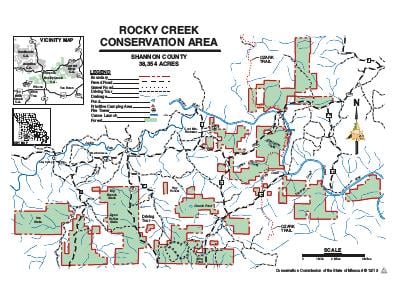
Driving DirectionsThe Rocky Creek Conservation Area contains over 38,000 acres in the south and east parts of Shannon County. Major tracts can be accessed from Highway 19, Routes H, and E going south off of Highway 106. Additional tracts are located north and south of Highway 106 starting five miles east of Eminence, continuing to the Reynolds County line. Tracts vary in size from over 6,000 acres to 80 acres. Access to areas varies from paved roads to unimproved woods roads, to areas that are only accessible by foot. Detailed ownership maps are available from the Eminence District Office.
HighlightsWith almost 40,000 acres of public land, the Rocky Creek Conservation Area provides for a wide range of outdoor activities. These include nature viewing, bird watching, hiking, dispersed primitive camping, and, of course, many hunting and fishing opportunities.Rocky Creek provides access to the Current River just south of the Highway 106 bridge near Powdermill and Owls Bend east of Eminence. The conservation area is also home to a auto driving tour that explores a 1,300 acre pine oak woodland restoration project.
About This AreaThe Rocky Creek Conservation Area is located in the Ozark Highland Section and the Current River Hills Subsection. The majority of the conservation area is in the Oak - Pine Woodland / Forest Hills Land Type Association (LTA). The remaining area is in the Eminence Igneous Glade / Oak Forest Hills LTA that includes Coot, Peter Mooney, Mill, Barnett, and Vance mountains.The area is managed with a sustainable ecological approach to multiple-use management. RCCA is a forested landscape resulting from The Great Cutover around the turn of the century. Today woodlands are covered by mostly even age black oak, scarlet oak, white oak, hickory and some shortleaf pine. Although the conservation area is in the native shortleaf pine range, many pine sites have been invaded by other hardwoods species that are now past or reaching maturity.The area also contains many springs, caves, and karst features that contain some of the rarest plants and animals in the state. The RCCA is the focus of ongoing natural community restoration projects in forest, woodlands, and glades. These projects are designed to improve the systems overall health and vigor and provide for a diverse range of wildlife habitat.Management techniques include prescribed fire, exotic species control, planting, forest thinning and regeneration projects. Other areas are set aside for old growth type habitat where man will not have any influence over time.