 Written by Justin Park|
Last updated
While most hunters are all too familiar with navigating public and private land boundaries in pursuit of game, backcountry skiers are relatively less impacted by access issues. The mountains where skiers trek away from chairlifts are more often in National Forests and other public lands and accessed along known routes and trailheads.
To bring awareness to access challenges and threats to public lands to the skiing community, Griffin Post, a pro skier and hunter, partnered with mapping software giant OnX to produce Inaccessible, a film about his attempts to ski Montana’s Crazy Mountains.
“As hunters and anglers, we deal with inaccessible public land all the time, but talking to my peers in the ski and snowboard world, they’re largely unaware [of the issue],” says Post.
The film premiered on December 9th at the Boulder Theater in Boulder, Colo., to a packed house who came for the film and a Q&A with the athletes alongside conservation leaders. I was there for the premiere.
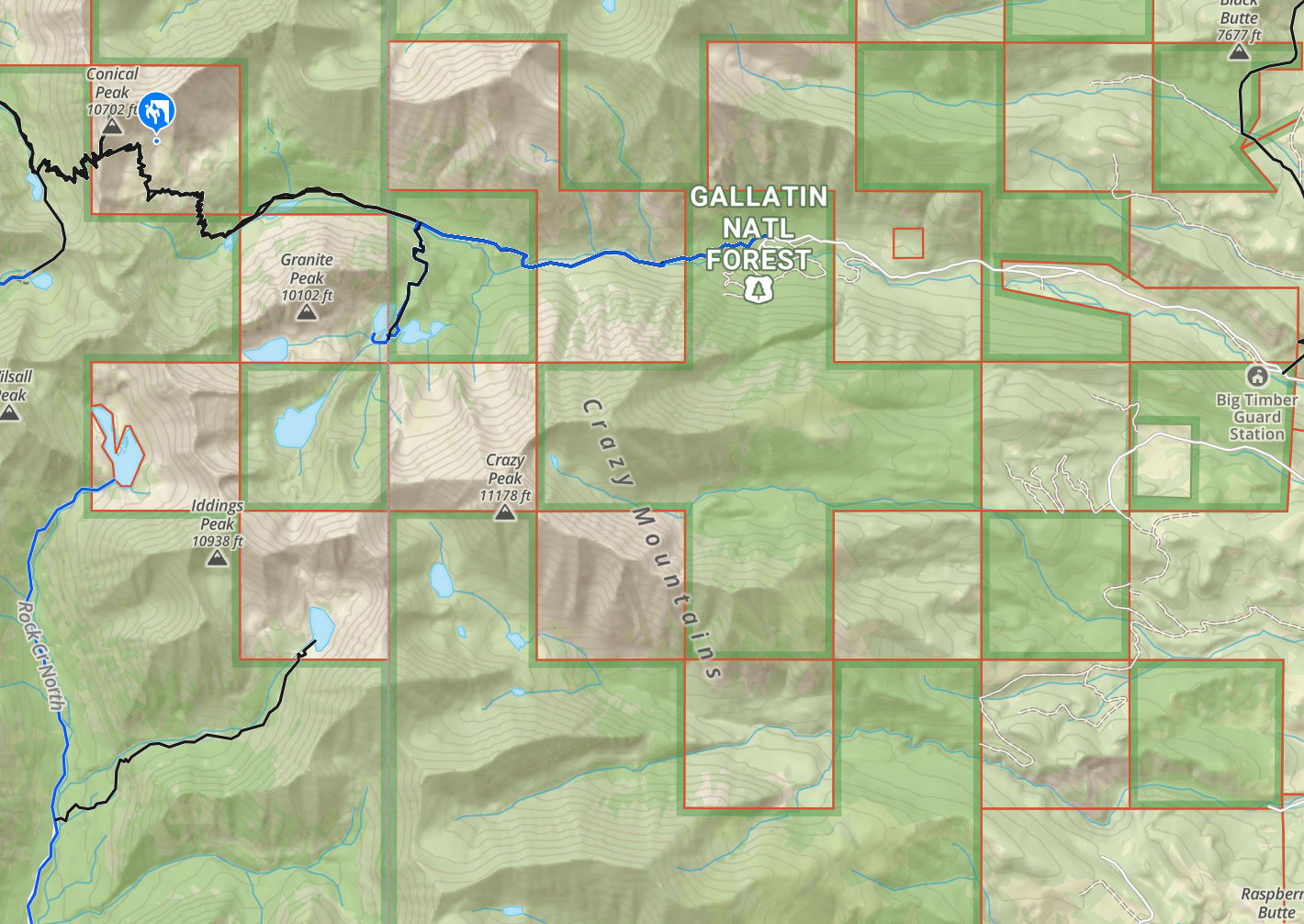
Map showing public and private 'checkerboard' land
How Land Boundaries Restrict Access
Before it gets into the ski action, Inaccessible does a great job summarizing the history and impact of the “checkerboard” pattern of public and private squares of land in the West.
Western hunters, especially in the Northern Rockies, will be familiar with this relic of Westward expansion that led to the recent “corner crossing” court case.
Post pegged the Crazy Mountains in Montana for his film because, unlike many mountain ranges popular with skiers, these peaks are overlaid with the checkerboard pattern of land ownership (see image below).
In pursuit of their ski lines, Post and his fellow pros are forced to snowmobile miles from their camp around squares of private land to reach the summit of their preferred peak for a descent.
While this sort of circuitous route-finding is common for Western hunters, the film shows skiers and other public land recreationalists how this artifact of the settling of the West can affect anyone trying to use public lands.
Answers for Access
The film highlights the challenges for access and advocates fighting to preserve existing public lands, but in the Q&A following the premiere, Jim Petterson of the Trust for Public Lands, described one way to go a step further and start to remedy the checkerboard challenge.
Conservation organizations such as TPL and the Rocky Mountain Elk Foundation often acquire key private parcels and convert them into public lands. These transfers open up access to landlocked or difficult-to-access public lands, and as Petterson told the film’s audience, “10 acres can open 10,000 acres.”
Whether hunting or backcountry skiing, there are also ways to utilize private lands to gain access to hard-to-reach public lands. Many states offer walk-in access programs which incentivize landowners to provide public access to private properties for hunting and other recreation.
The public can also leverage land leasing sites such as HLRBO to pay for short- or long-term access to private parcels. If you’re looking for a way to gain better access to a certain area, use the map search feature on HLRBO to look for available leases in the area.
Inaccessible will be showing at several film festivals and is streaming online as of December 10. More information on the film is available on the OnX website.
Justin Park is a Colorado-based writer, editor, and avid hunter with a passion for the outdoors. He contributes to leading publications such as GearJunkie, Popular Mechanics, Powder, and Men's Journal, and serves as Editor of Wild Snow. Park is deeply involved in conservation and recreation advocacy, serving as Chapter Chair of the Rocky Mountain Elk Foundation (RMEF) in Summit County. He also represents RMEF on a state recreation committee focused on proactively addressing land use conflicts.