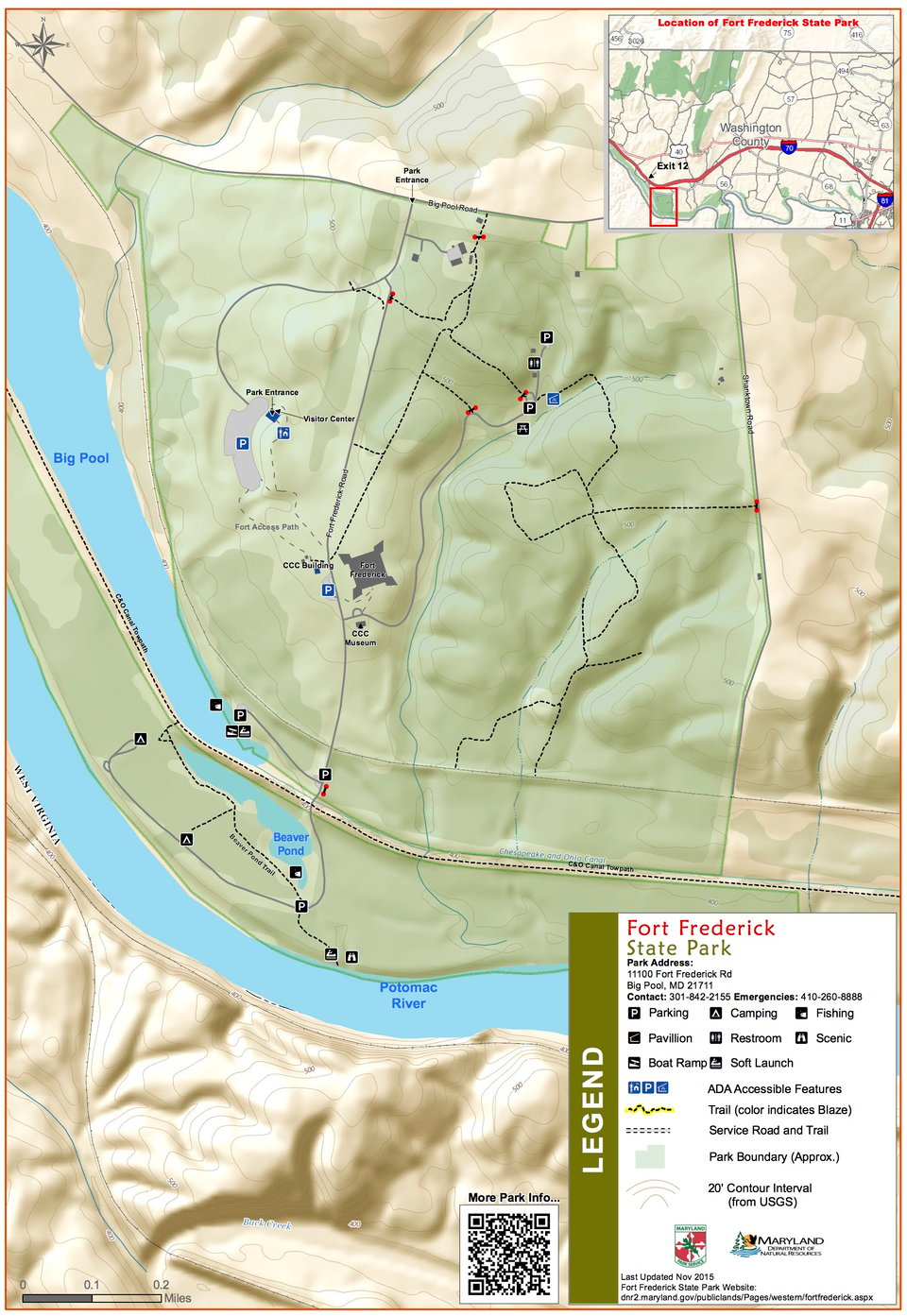
American history from the colonial period to the presentAerial view of Ft. Frederick can be discovered at Fort Frederick State Park. Our 585 acre park features a unique stone fort that served as Maryland’s frontier defense during the French and Indian War. The Fort's stone wall and two barracks have been restored to their 1758 appearance. Historic exhibits are in the Fort, barracks, CCC Museum and Visitor Center. The park annually holds programs such as artillery firings, junior ranger, colonial children’s day and the 18th Century Market Fair. The park borders the Potomac River, and the Chesapeake and Ohio Canal passes through the park. The park also features a boat launch, campsites, camp store, fishing, flat water canoeing, a hiking trail, interpretive and educational programs, picnicking, a playground, and a shelter. For more information on facilities, hours, and programs please contact the visitor center.
The stone fort built in 1756 protected Maryland’s frontier settlers during the French and Indian War. Fort Frederick is unique because of its strong stone wall, large size, and roomy barracks. Fort Frederick also saw service during the American Revolution as a prison for British soldiers. For the next 131 years, the fort and surrounding lands were farmed. During the Civil War, Union troops were often stationed near the fort to guard the C & O Canal. In 1922, the State of Maryland acquired the fort. During the Great Depression of the 1930's, a company of the Civilian Conservation Corps restored the fort and began development of the state park. In 1975, the park reconstructed two soldier’s barracks inside the fort. These barracks are open seven days a week from Memorial Day to Labor Day and on the weekends in the spring and fall. During those times, staff and volunteers dressed in 18th century clothing occupy the fort, demonstrating daily life in the 18th century.