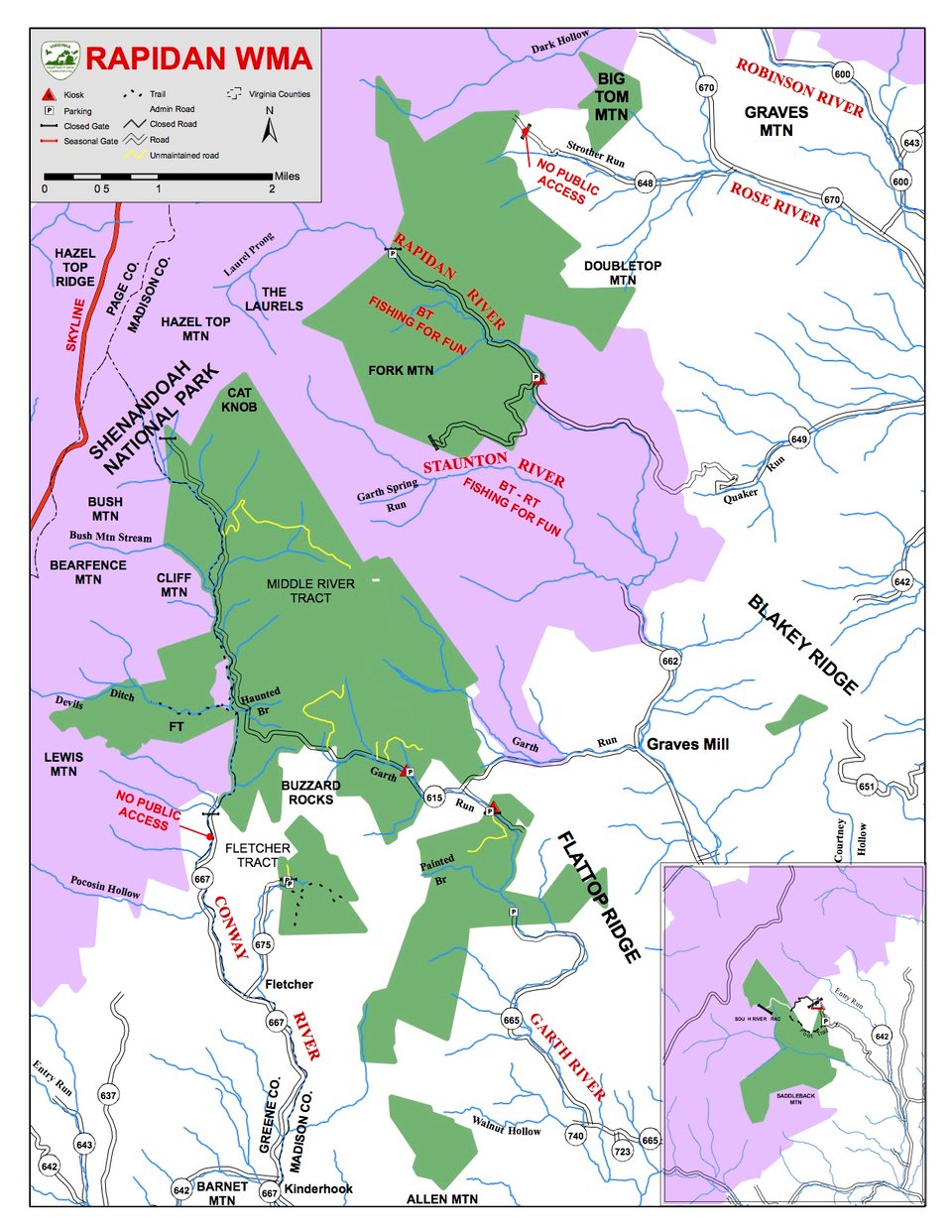
Perhaps nowhere is there a more beautiful stream than the upper reaches of the Rapidan River at full stage, or mature mixed hardwood forests than those in the area’s deep, moist hollows. From these narrow, rocky stream courses and deep valleys rise rugged mountains, many having steep slopes and adorned with forbidding laurel thickets. Welcome to the Rapidan Wildlife Management area.
The area consists of 10,326 acres broken into eight separate tracts distributed along the east slope of the Blue Ridge Mountains in Madison and Greene Counties. Four of these tracts adjoin Shenandoah National Park and share nearly 25 miles of boundary. Elevation ranges from 1,400 to 3,840 feet. The Rapidan, Conway, and South Rivers are the area’s major streams. Prior to the Department’s ownership, most of the area was forested, though frequent timber harvesting took place by a succession of timber companies. Timber type is predominantly mixed hardwoods with southwestern slopes harboring chestnut oak forests. Most of the deep valleys and slopes are predominantly tulip poplar forests. However, relict northern hardwood forests of sugar maple, yellow and black birch can be found in higher elevations and in a few of the deep drainages. Evidence of steep mountain roads, old home sites and cemeteries, and rock piles, left over from field clearing and farming, still linger as a testament to the sturdy mountaineer families that once lived in this area. Some older, mature timber dead and dying from gypsy moth infestation was salvaged in the late 1980’s.
Deer populations, though moderate in numbers, remain stable and provide quality hunting opportunities. Turkey numbers remain stable as well. Gray squirrels and ruffed grouse can be found throughout the area. The rugged terrain and remoteness of the Rapidan WMA, and its close proximity to the Shenandoah National Park make the area a premier location for black bears. Woodcock are readily found in some of the wetter sites near old house sites and along some of the large streams. The Rapidan WMA is diverse in habitat types and is managed through periodic timber harvesting and maintaining small clearings.