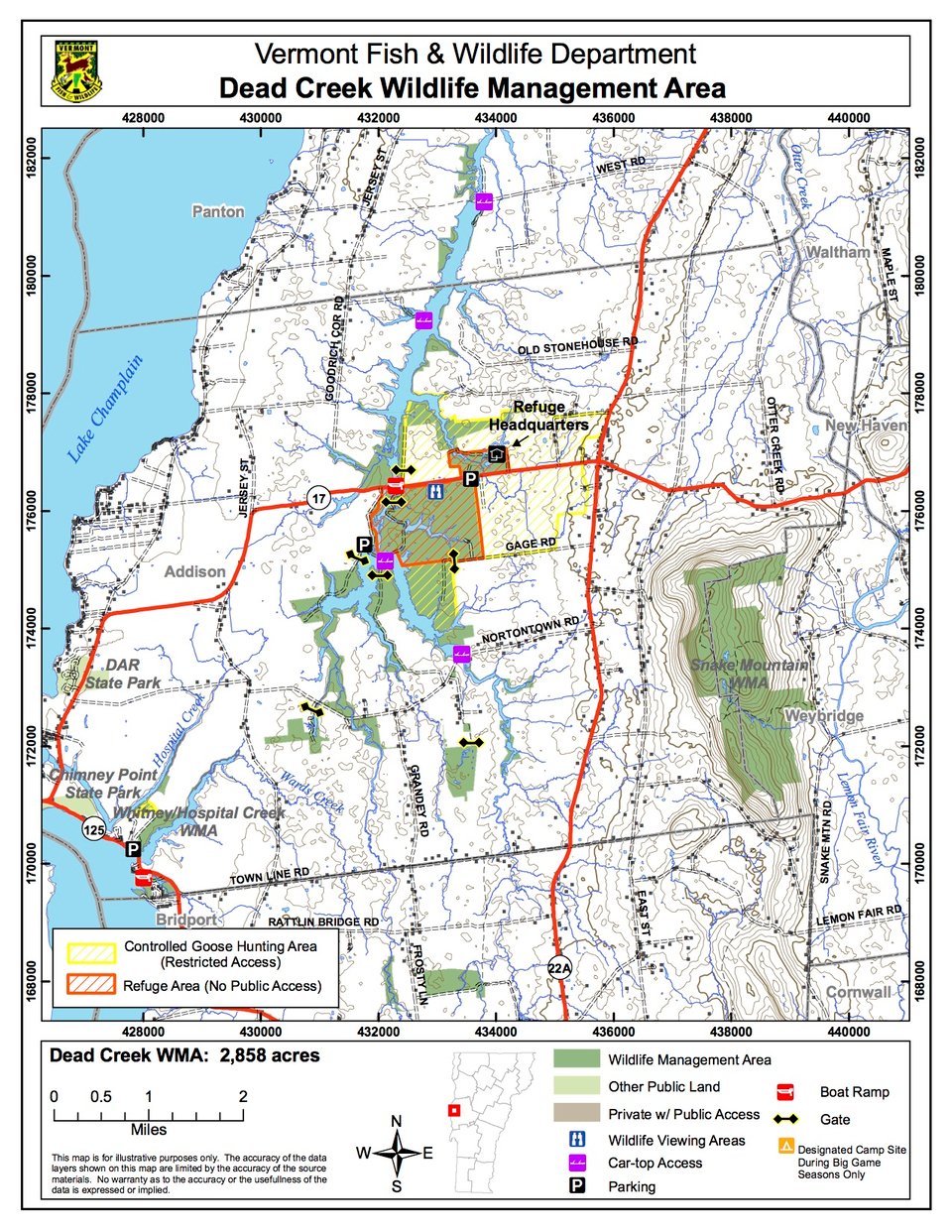
Dead Creek Wildlife Management Area (WMA) is a 2,858-acre tract in the towns of Addison, Panton and Bridport. A public viewing area is located along the south side of Route 17, one mile west of Route 22A, that provides excellent viewing of the huge fall concentrations of Canada and snow geese. There is also a small boat access on Route 17 as it crosses the Creek.
This WMA has seven impoundments that create cattail- dominated wetlands. Water levels are actively managed. Surrounding uplands are a mix of active agricultural lands, old fields and clayplain oak-hickory forests. Hunting, fishing and trapping are allowed on portions. Access to sections of the WMA is regulated because the area is primarily a waterfowl refuge. Dead Creek WMA is owned by the State of Vermont and managed by the Vermont Fish & Wildlife Department.
Dead Creek originally flowed north sluggishly to Otter Creek through a fairly flat valley. Construction of dams has created impoundments and added much more open water and cattail marsh.
The soils in the area are mostly fine clays that inhibit drainage. The oak-hickory clayplain forest community is adapted to such poorly drained soils. This was a widespread community in the Champlain Valley before European settlement. Dominant tree species are shagbark hickory, white oak, swamp white oak, red oak, burr oak and white pine. Hophornbeam is the most abundant subdominant tree.
Besides open water, there is extensive emergent cattail marsh in Dead Creek WMA. There is also broad-leaved emergent marsh, deep bulrush marsh and buttonbush swamp. Pondweeds, broad-leaved arrowhead, arum-leaved arrowhead, waterweed. swamp-milkweed, bristly sedge, big-headed bulrush, wool-grass and water-dock are some of the aquatic plants that occur. One may find flowering rush, which is naturalized from Europe. Parasitic dodder, jewelweed and sweet joe-pye weed grow on the banks.
Some areas are managed for moist soil. They are flooded for brief periods and then drained, and support plant species which enhance waterfowl habitat in the fall. Drawdowns benefit migrating shorebirds which are attracted to mudflats and shallow water held for them until late summer. The uplands are a mixture of farmland, old fields and clayplain forest. The farmland and old fields are managed to improve wildlife habitat. In many areas there is a dense line of shrubs ringing the marshes, which provides wildlife cover and food. These shrubs include chokecherry, meadow-sweet, downy arrow-wood, gray dogwood, round- leaved dogwood and prickly ash.