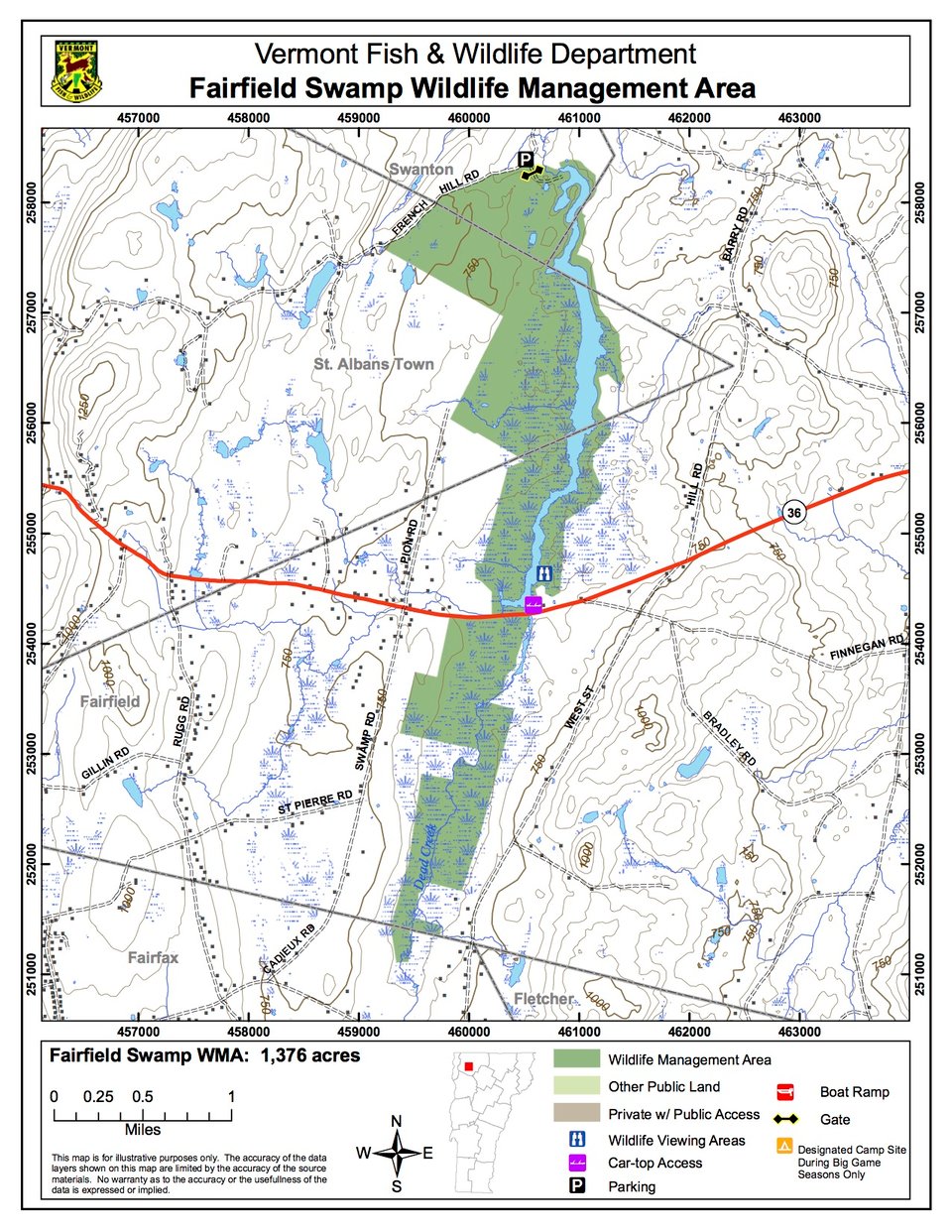
Fairfield Swamp Wildlife Management Area (WMA) is a 1,376-acre tract located mostly in the town of Fairfield. It includes a large wetland complex with adjoining upland forests. It is owned by the State of Vermont and managed by the Vermont Fish & Wildlife Department. Dead Creek, which flows north through the WMA, was dammed in the 1960’s to create more wetland habitat. The swamp can be accessed from the parking area east of the causeway on Route 36 in Fairfield where there is a canoe put-in and wildlife viewing area. There is also a woods road for foot traffic near the dam at the northwest end of the WMA.
Fairfield Swamp consists of a part of Dead Creek and its associated wetlands. All of the land is low-lying at an altitude of about 850 feet, There is an adjacent area of upland covered with northern hardwood forest. Within the large wetland complex are open water leads, sedge meadow, black spruce- tamarack bog, shrub bog, and cattail, deep bulrush and deep broadleaf marsh. There are also shrub and forested swamps, especially alder and red maple-northern white-cedar swamps. There is a fen in an area with very poor drainage. This variety of habitats is ideal for a variety of wildlife, especially water birds and amphibians.
There are several species of rare plants in Fairfield Swamp, especially in the fen. These include the State’s only known example of autumn-willow, and the white-fringed orchid. More common, but still relatively rare, are the carnivorous pitcher plant and uncommon rose-pink. Because access in such a swamp is difficult, it is likely there are more rare species that have not been discovered. Rare birds which nest in the WMA
are sora, common
moorhen, and least
and American bitterns.
Two
significant natural
communities
occurring in
Fairfield Swamp
are deep bulrush
marsh and black
spruce-tamarack
bog. Bulrushes grow in large mats over standing water up to 6 feet deep. They provide feed and cover for water birds. The black spruce bog is home to the rare bog plants noted above. There is also extensive alder swamp in the WMA, which provides shelter and nesting habitat for a variety of songbirds.