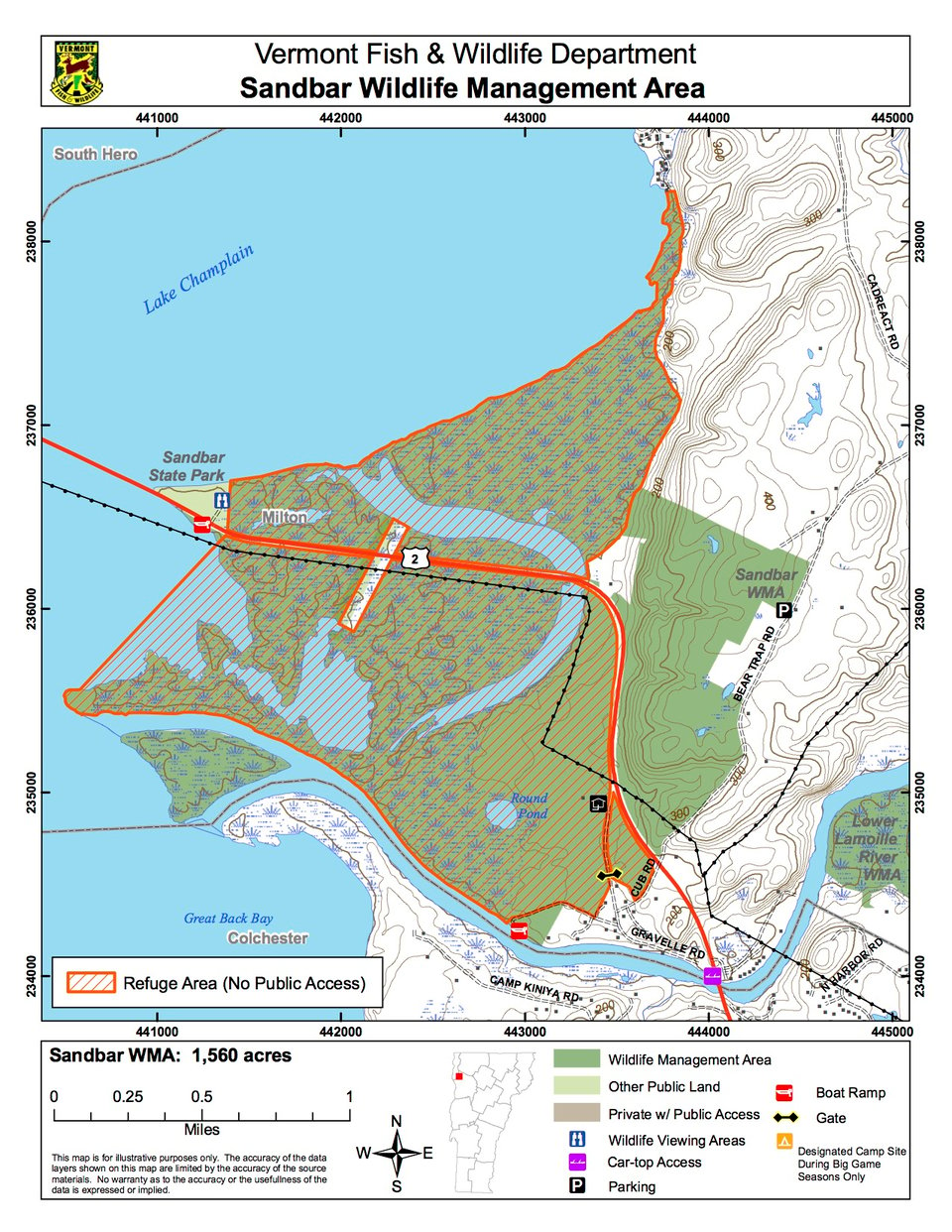
Sandbar Wildlife Management Area (WMA) is located in the town of Milton and borders Lake Champlain on either side of Route 2. Most of its 1,560 acres are a refuge with no public access. However, the upland portion of the WMA northeast of Route 2 is open for public use, as is Delta Island. One may also boat along the Lamoille River and in nearby Lake Champlain, or drive along Route 2 and stop at pull-offs there. Sandbar State Park and the Sandbar Causeway to South Hero are other areas from which one may observe wildlife in the refuge. Boats may be put into the Lamoille River at the boat access off Cub Road, or into the Lake across from Sandbar State Park. The WMA is owned by the State of Vermont and managed by the Vermont Fish & Wildlife Department.
The Lamoille River has built an extensive delta at its mouth in Lake Champlain, and this comprises the majority of the WMA. This includes an abandoned channel that extends through the wetland north of the river. The channel bed is at lake level and supports luxuriant aquatic vegetation. Earthen dikes were constructed to control water levels in the marsh.
This WMA is 70% wetland and 30% forested upland. The wetlands are a mix of open water emergent marsh and floodplain forest. The marshes contain water and yellow pond lilies, pickerelweed, sago and large-leaved pondweed, spiked water milfoil, bladderwort, duckweed, arrowhead species, water-plantain, cattail, three-way sedge, other sedge species, rushes, bulrushes, water-dock, water smartweed, buttonbush, winterberry, and one of the finest stands of wild rice in the State. Blue flag, sweetflag, least spike-rush and burreed grow along the shores. The forest is mentioned in land survey notes from the late 1700’s and was apparently much the same as it is today. Some of this original sandplain forest community still remains. Swamp white oak-silver maple forest occurs along the river in the rich alluvial soils - perhaps the largest stand the State. There are some nearly pure stands of silver maple. Eastern cottonwood, American elm and red maple are also found. The uplands are a mix of hemlock, white pine, northern white-cedar, red oak, aspen, gray birch, shagbark hickory, white ash, and red and sugar maple. There are some small fields and several large forested bluffs as well.
Wild rye is one unusual plant found in the refuge. The State-endangered osprey has made a dramatic comeback in the Sandbar area. State-endangered spiny softshell turtles sometimes are seen sunning themselves along the Lamoille River. Remember that it is illegal to harm or harass endangered animals. Viewing them from a distance with binoculars is recommended.