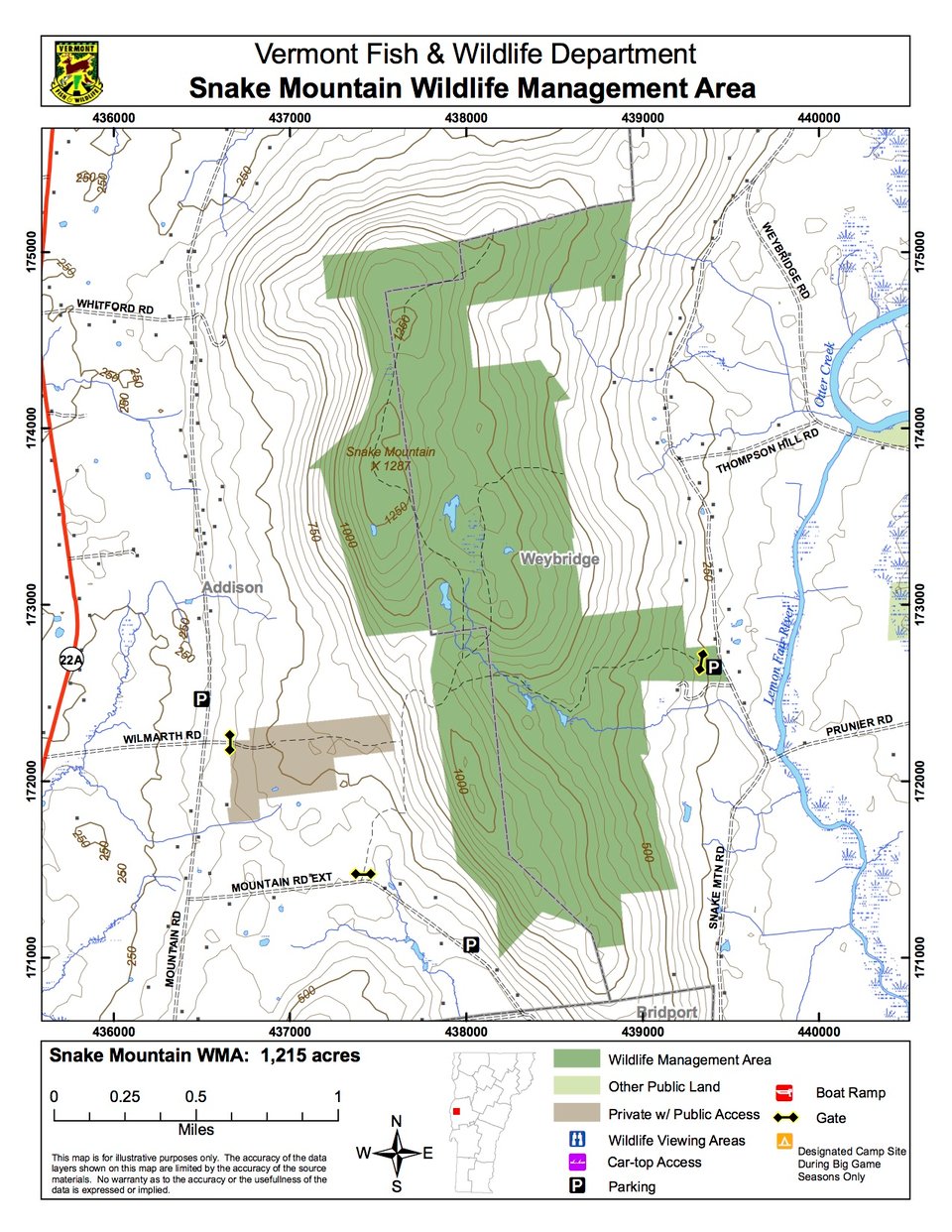
Snake Mountain Wildlife Management Area (WMA) is located in west central Vermont in the towns of Addison and Weybridge. Its 1,215 acres span the upper slopes and summit of Snake Mountain. Access is from parking areas on Mountain Street near Wilmarth Road, Mountain Street Extension, and Snake Mountain Road south of Thompson Hill Road. There is a network of walking trails that crisscross the mountain. One popular day hike is to the summit from the Mountain Road parking lot. There are great views of the Lake Champlain Valley and the Adirondack Mountains from the summit. Some of the trails cross private land; please be respectful.
The WMA is owned by the State of Vermont and managed by the Vermont Fish & Wildlife Department. Timber rights are privately owned. Management goals for this area are to conserve wildlife habitat and provide public access.
Snake Mountain is a prominent feature in the Champlain Valley, jutting up from the surrounding level countryside, and reaching an elevation of 1,287 feet. As such, it is an island of upland forested habitat in the heavily farmed Champlain Valley. Most of the WMA is covered by northern hardwoods. However, there are several other forest communities which result in a great diversity of plants and wildlife. These include a mesic red oak forest growing on deep, rich, well-drained soils, a dry oak-hickory hophornbeam forest on dryer soils, and a mesic maple-ash– hickory forest. There are also hemlock stands and eastern red-cedar in old pasture lower down. There is temperate calcareous cliff and temperate acidic outcrop forests, both with many unusual plants, and a transition hardwood tallus wood. Hophornbeam is a dominant understory tree. Dwarf chinquapin oak and fragrant sumac are two unusual woody plants found in the WMA.
Herbaceous plants are diverse, including white trillium, dog’s-tooth violet, bloodroot, sweet cicely, beech-drops, large-flowered bellwort, bishop’s-cap, hepatica, Canada- violet, dwarf ginseng, small-flowered buttercup, Christmas fern and rattlesnake fern. Back’s sedge, four-leaved milkweed, handsome sedge, needle-spine rose, hair honeysuckle, large yellow lady’s-slipper, podgrass and squaw root. The State-endangered Douglas knowtweed has also been found.
There is a very interesting wetland near the summit known as Cranberry Bog. It is about 33 feet deep and more than 9,500 years old. It began forming shortly after the retreat of the last glacier in Vermont. There is an acre of open bog mat, comprised mostly of sphagnum moss. Pitcher plants are abundant, and round-leaved sundew and tawny cotton-grass are also present. Shrubs include bog rosemary, bog laurel and sheep laurel. Dense leatherleaf rims the outer edge of the mat. The surrounding bog forest is dominated by black spruce with larch, red maple and white pine. Highbush blueberry dominates the shrub layer in the bog forest; black alder and speckled alder grow as well.
The entire wetland area is very fragile. Please minimize disturbance to it, and especially do not walk on the bog mat. And remember, no plants may be picked on public lands.