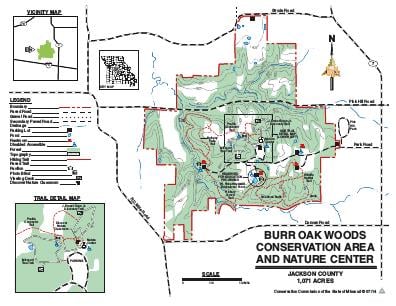
Driving DirectionsIn Blue Springs, take Highway 7 north of I-70 for 1.10 miles, then west 1 mile on Park Road to the area.
HighlightsThis area is mostly forested, but it also features established prairies, restored glades, savannas, woodlands, numerous ponds, and creeks. Facilities/features: A large nature center offering exhibits and interpretive programs, picnic areas, pavilions, six hiking trails, viewing/photo blind, and viewing decks and bridges. There is also Burr Oak Creek and scenic limestone exposures.
About This AreaNature Center Hours Tuesday – Friday: 7 a.m. – 6 p.m.; Saturday: 8 a.m. – 5 p.m. The Nature Center and area grounds are closed Thanksgiving, Christmas, New Year’s Day. Area Hours: 7 a.m. – 8 p.m. DST 7 days per week; 7 a.m. – 6 p.m. CST 7 days per week Closed on Thanksgiving, day after Thanksgiving, Christmas, New Year’s Day and all state holidays on MondaysFOR MORE INFORMATION: Burr Oak Woods Conservation Nature Center, 1401 NW Park Rd., Blue Springs, MO 64015-7727; Phone 816/228-3766; Fax 816/655-6267; www.mdc.mo.gov/areas/cnc/burroak/ or http://www.missouriconservation.org/ Burr Oak Woods Conservation Area is in Jackson County, 20 miles east of downtown Kansas City. The area is composed of 1,071 acres of woodlands, fields and ponds and includes a scenic portion of Burr Oak Creek.Burr Oak Woods was purchased in 1977. Its natural features include forested hillsides that quickly drop as much as 100 feet. Scattered limestone boulders and outcrops, with 8-foot-deep mazes through them, add interest to the area.Nearly 70 percent of Burr Oak Woods is forested and contains a wide variety of tree species, including bur oak, white oak, red oak, chinkapin oak, black walnut, hackberry, white ash, shagbark hickory, Kentucky coffeetree, and many others. Understory trees include roughleaf dogwood, redbud, pawpaw, slippery elm, and Ohio buckeye.Additional natural features include glades, fields, rock outcrops, ponds, wildlife, streams and native grass plantings. Open land and forest management practices that benefit wildlife such as native prairie plantings, food plots, brush piles, invasive species control, old field succession, savanna restoration, walnut agroforestry, a wild edible food plot, and an oak plantation can be seen along the main road. These practices are maintained by tree thinning, prescribed burning, or mowing. Several woodlands, savannas, and glades on the area have also been restored in the same manner. Visit the nature center to learn more about these land management practices.