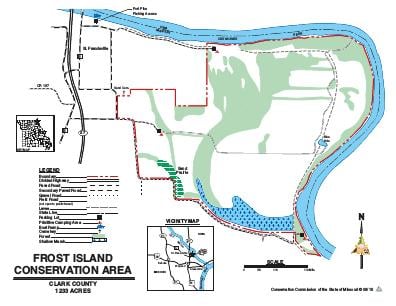
Driving DirectionsFrom Wayland, take Highway 27 north 4 miles, then on an unnamed gravel road east 1 mile.
HighlightsThis area is largely old fields with forest, cropland, wetlands and prairie. Facilities/features: primitive camping and a permanent stream (Des Moines River).
About This AreaIn 1996, seven tracts totaling 916 acres were acquired as part of the Emergency Wetland Reserve Program (EWRP), which was initiated after the flood of 1993 which lasted for 175 days. This flood damaged the area's farmland by depositing large amounts of silt and sand in some areas and scouring in other areas. Flood protection levees were not repaired to allow future flood waters to inundate the area and reduce flood damage downstream.An adjacent upland tract and a small tract along the Des Moines River was purchased later to bring the area to its present size of 1,232 acres. The Des Moines River bounds the area on the north and east sides, providing two miles of river frontage. The lowland areas of Frost Island CA contain old crop fields, food plots, grass plantings, and some bottomland hardwood forest. The upland portion of the area is a high sandy terrace.Unique natural features exist on the area. A natural oxbow slough, locally known as "McGuire's Hole," is on the area's south boundary. This naturally occurring wetland and adjoining sandy terrace is ideal nesting habitat for some rare or locally uncommon reptiles. The terrace also supports a small remnant sand prairie. The prairie hosts a variety of sand-adapted plants, a few of which are listed as rare in Missouri, and many others that are regionally uncommon.Frost Island CA is managed to enhance some of the natural features including the restoration of wetland vegetation and hydrology, and expanding the sand prairie. Portions of the area are reverting naturally to willows and cottonwoods, expanding the riparian buffer along the river and the natural oxbow.The open land is managed for upland wildlife such as quail, pheasant, dove, deer, and turkey. Management activities include burning, discing, haying, and cropping.