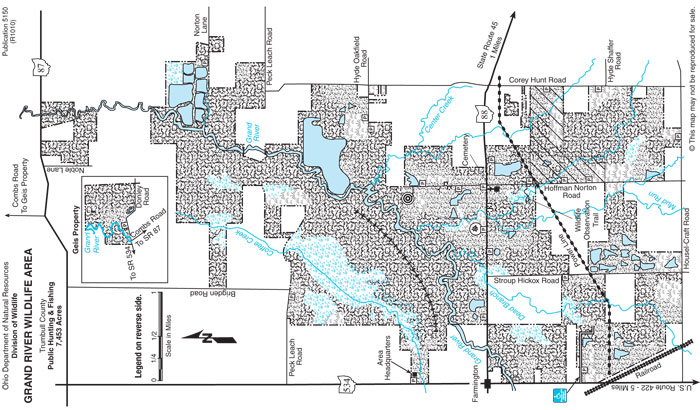
The Grand River Wildlife Area is in northeast Ohio, just east of West Farmington. State Route 88 bisects the area in an east-west direction, and State Route 534 borders the area on the west. Trumbull County Roads Stroups Hicrox, Hoffman Norton, and Corey Hunt run parallel to Route 534 through the area.
The 7,664-acre area is flat to gently rolling. Numerous beaver impoundments, and over forty man-made marshes can be found here. The Grand River and five tributary streams meander through the wildlife area, subjecting much of it to flooding during heavy rains and spring thaws. About 46 percent of the area is second growth hardwoods, 49 percent is openland, cropland, and brushland, and 5 percent is wetland and water.
On this area, and on private lands to the north, are extensive swamp forests which were once typical of much of northeast Ohio. This portion of the Grand River valley is one of the largest areas of semi-wilderness remaining in heavily populated northeast Ohio, and probably the only public hunting area in the vicinity where even the experienced outdoorsman should take precautions against becoming lost.
The pristine, meandering Grand River and its tributaries provide good habitat for colonies of beavers. The combination of beaver impoundments, good water quality, and a large variety of fish species has made it possible to reintroduce river otters here. During the winter of 1986-87 an initial experimental release was made in an attempt to establish a reproducing population of otters in the Grand River watershed. Another release was made in spring 1988. Current river otter populations have expanded so dramaticaly throughout the state that their endangered species status has been removed. In 2005 Ohio initiated its first river otter trapping season.